Ereshkigal — Fate/Grand Order
BiographyBiography
The story, the personality, and everything in between.Read biographyClose biography
Biography
The story, the personality, and everything in between.Read biographyClose biographyEreshkigalエレシュキガル
Mesopotamian goddess and ruler of the underworld; Lancer-class Pseudo-Servant
Ereshkigal is the Mesopotamian goddess of the underworld in Fate/Grand Order, introduced as a formidable but unexpectedly earnest figure in the Seventh Singularity, Babylonia. The ruler of Kur tends the souls of the dead and commands the realm through divine authority, yet her stern proclamations poorly conceal a diligent, self-conscious wish to be understood. In her summonable Lancer form she is a Pseudo-Servant using a human vessel associated with Rin Tohsaka, which helps distinguish this incarnation from the distant goddess of myth.
Her uneasy place beside her sister Ishtar and the Three Goddess Alliance brings her into conflict with Chaldea and the city of Uruk.
Biography
A queen whose world lies below
From the beginning of her divine existence, Ereshkigal is assigned to rule the Mesopotamian underworld. Her task is to receive and oversee the departed, not to travel freely through the world of the living. This lonely office makes Kur both her domain and her burden: she knows its laws intimately, but has scarcely experienced the sunlight and companionship that other gods take for granted.
Fate/Grand Order presents her as a Pseudo-Servant rather than an unmodified manifestation of the ancient goddess. A compatible human vessel, identified with Rin Tohsaka, tempers some of the severity attributed to her older divine nature. Her concern for the souls under her care is apparent even when she tries to sound frightening.
The other side of Ishtar
Ishtar, associated with the heavens and life, is Ereshkigal’s sister and recurring foil. Their shared human appearance can make them easy to confuse, but their dispositions differ sharply: Ishtar acts with a more outwardly impulsive confidence, while Ereshkigal is restrained by duty and quick to become embarrassed. In Babylonia, Ereshkigal sometimes approaches Fujimaru while passing herself off as Ishtar.
Ereshkigal is one of the Three Goddess Alliance members opposing Uruk. Her participation is bound up with the plight of humanity and her belief that keeping souls in her own domain can serve as protection, even as her methods threaten the living. This conflict is a central part of the Babylonia storyline; the later resolution belongs to the spoiler section.


Ruler of Kur, not merely a combatant
Within the underworld, her authority is far more than a weapon. She controls the realm’s gates and conditions, can confine souls with cage-like spears, and can grant protection to those fighting under her favor. Her power is tied to her jurisdiction rather than unrestricted control of the entire surface world. Her responsibilities also shape her outlook: a quiet resting place for the dead matters to her as much as defeating an intruder.


Personality and Motivations
Ereshkigal is formal, proud, and deeply conscientious. She speaks as a fearsome queen but often reveals that she has spent far more time working alone than learning to be at ease with people. She can become flustered by a kind remark, then hurry to restore a dignified tone. This is not simply a comic mask: she genuinely sees stewardship of the dead as a serious obligation.
The contradiction between her threatening public image and her attentive conduct defines much of her appeal. She worries about the comfort of souls in her custody, secretly wants recognition for her labor, and is sensitive to comparisons with Ishtar. Her pride can become possessive or severe, but her Pseudo-Servant incarnation also recognizes the cruelty in impulses that an earlier goddess might have accepted.
Her reserve does not mean she has no feelings. Once someone treats her as a person rather than a symbol of death, her gratitude is strikingly sincere, though often disguised with prickly qualifications. She is best understood as an isolated ruler learning that a duty can be honored without erasing the person who performs it.
Appearance
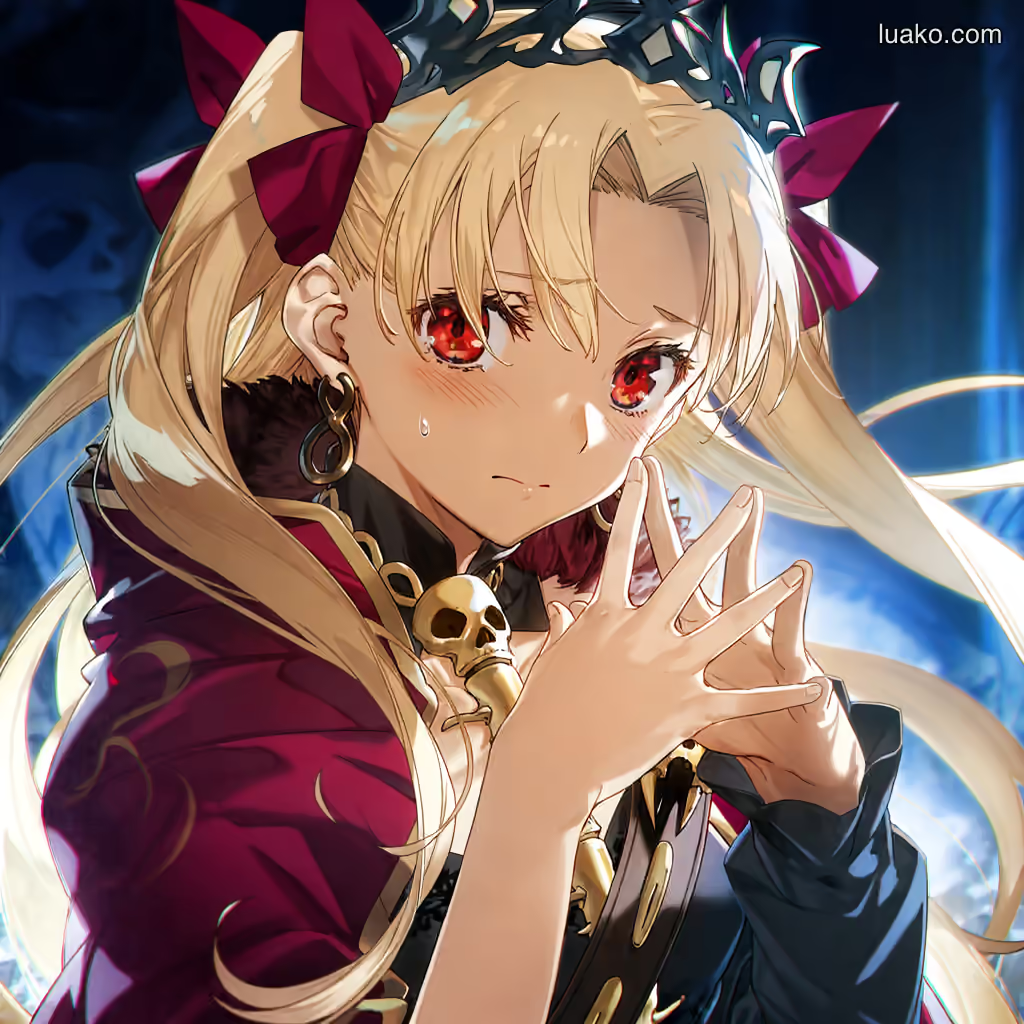
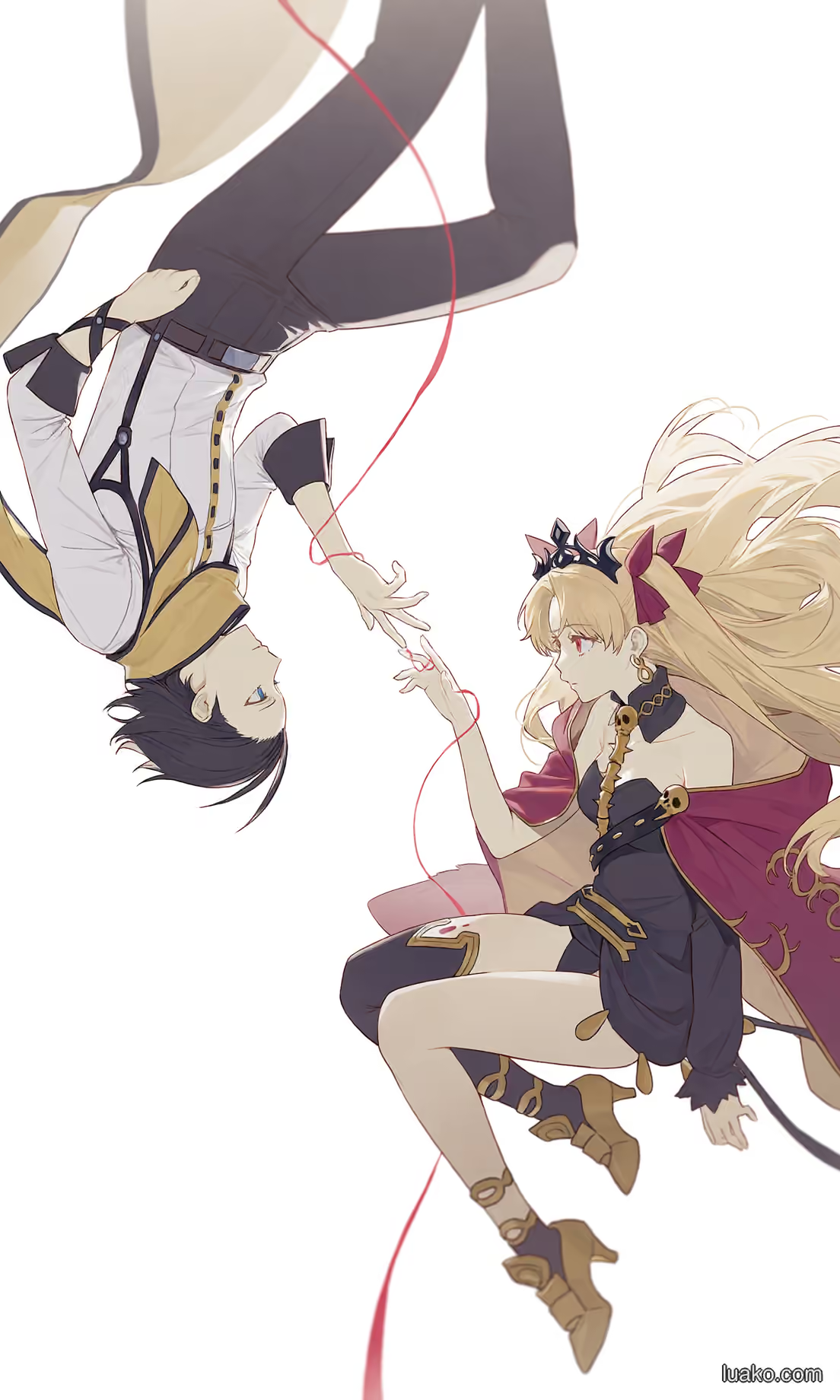
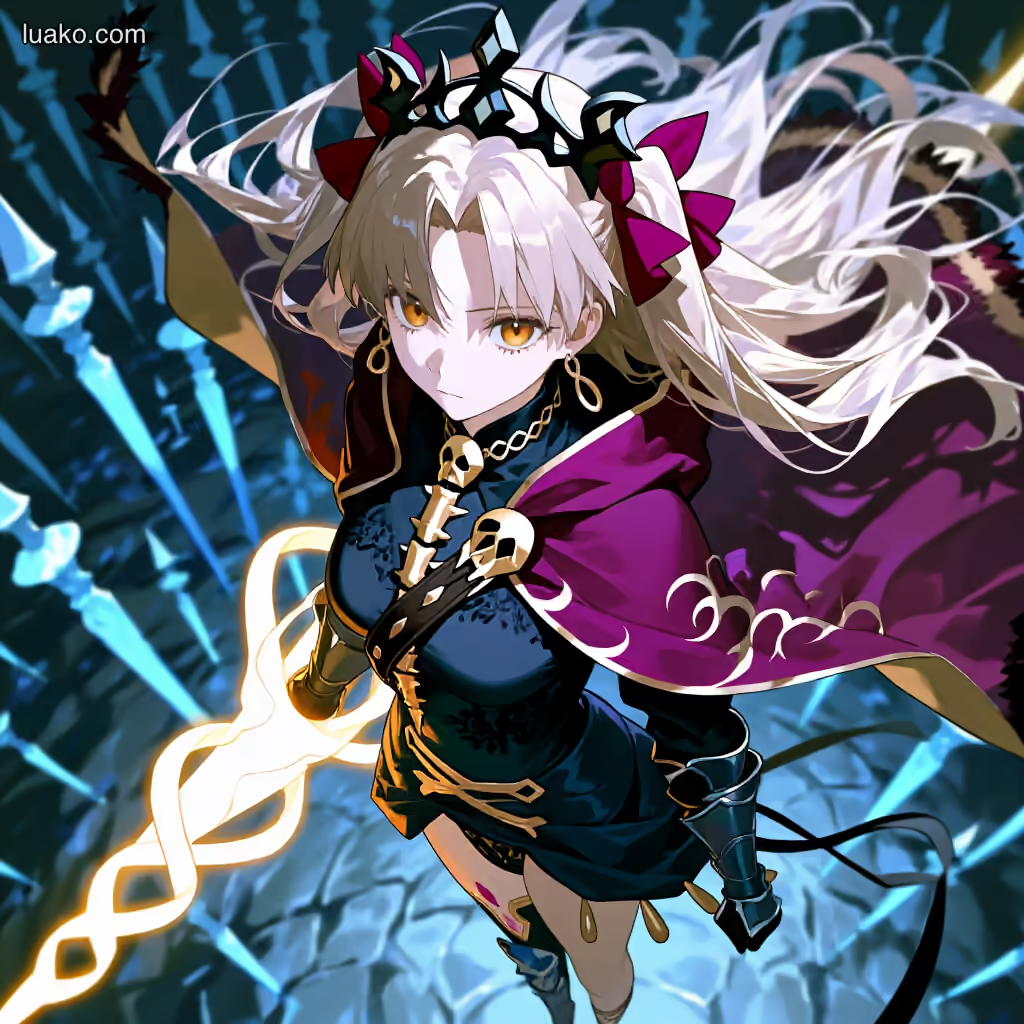
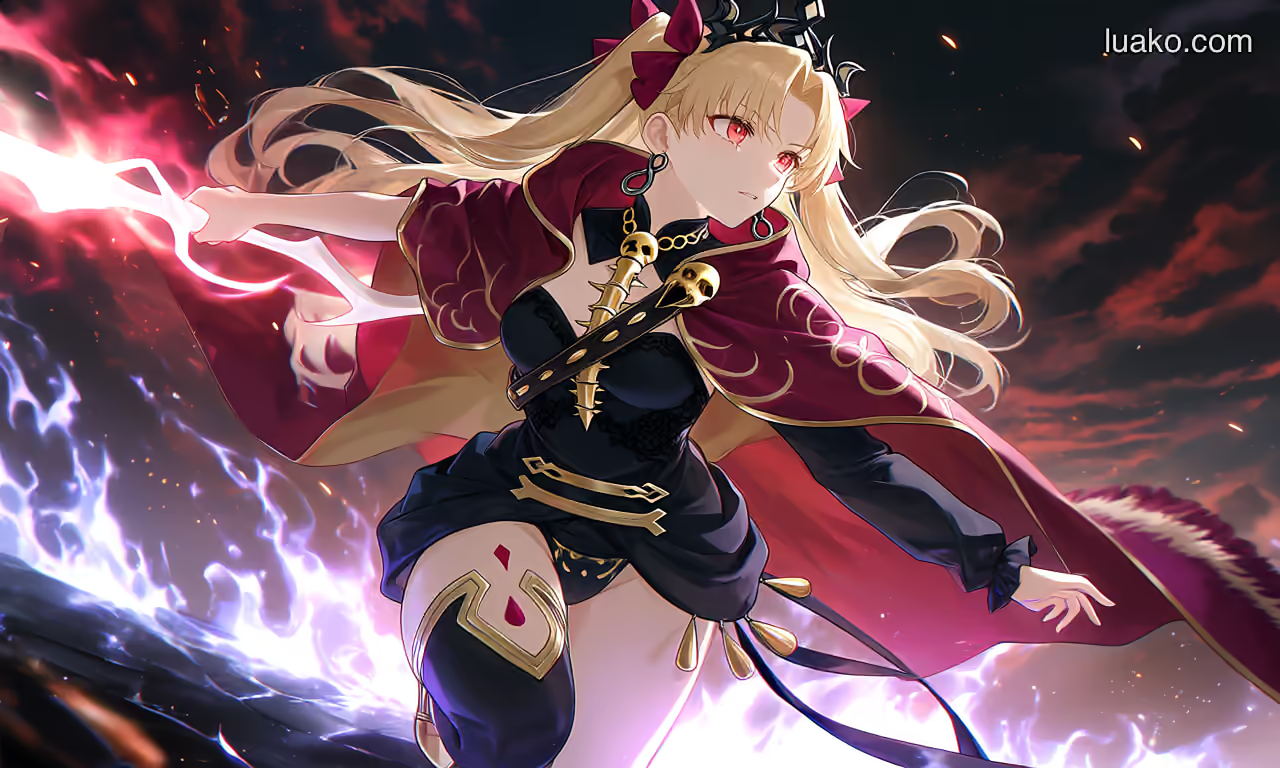
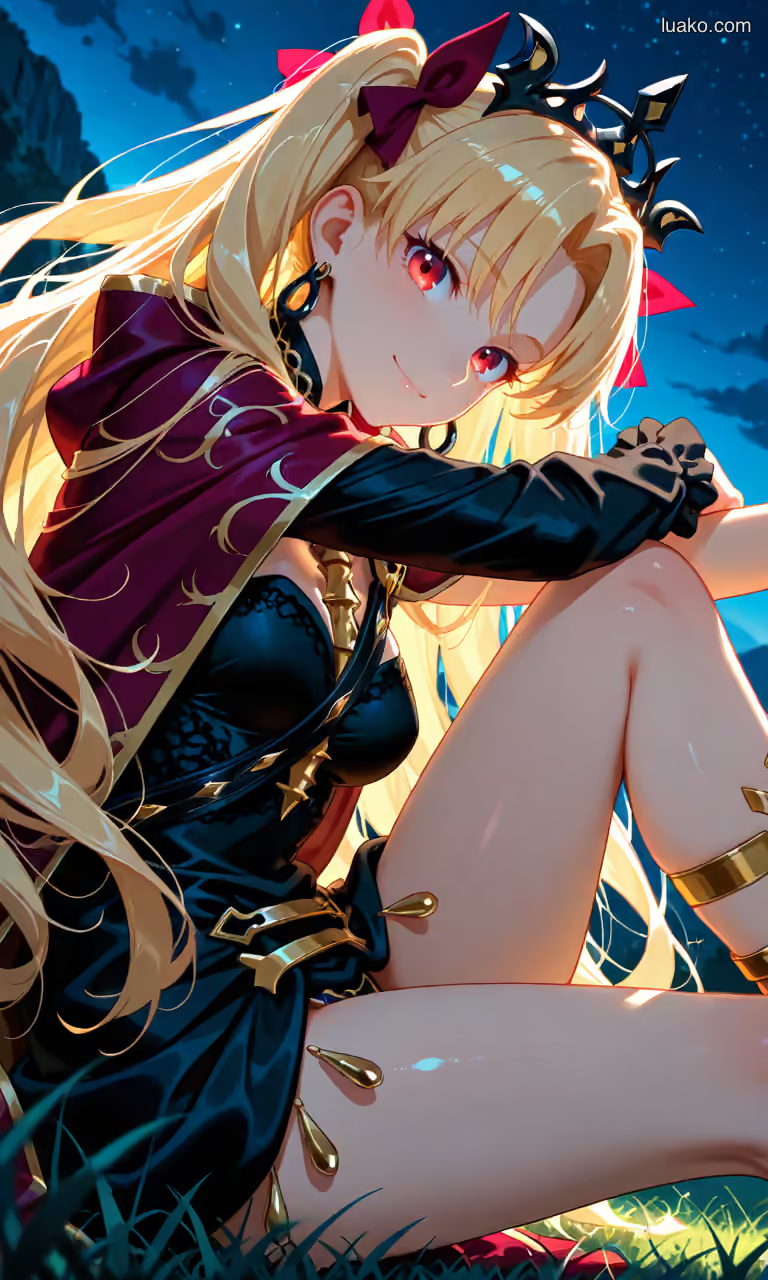
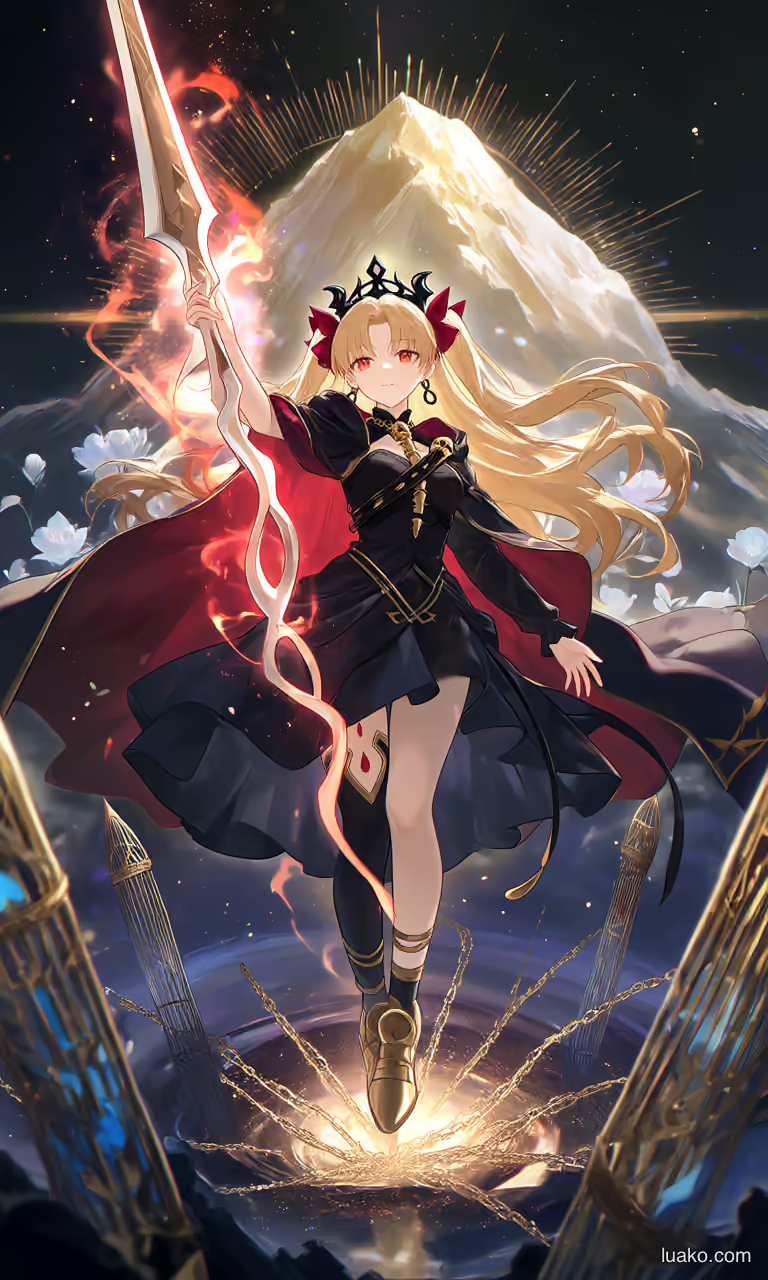
Her Lancer design features long blonde hair and red eyes, a dark crownlike headpiece, and predominantly black ceremonial clothing accented by red and gold. Flowing fabric, chains, and an imposing spear or cage-shaped implement give her the look of a young queen whose authority reaches far beyond her apparent size.
Because she and Ishtar manifest through the same human-associated appearance, their resemblance is deliberate rather than a claim that they are one interchangeable character. Ereshkigal’s darker costume and underworld-themed weaponry distinguish her own Servant presentation; later alternative appearances should not be confused with her standard Lancer design.
Quick facts
- Servant class
- Lancer
- Divine domain
- Kur, the Mesopotamian underworld
- Manifestation
- Divine Spirit Pseudo-Servant
- Human vessel
- Rin Tohsaka
- Origin
- Ancient Mesopotamian mythology
- Recorded height
- 159 cm
- Associated group in Babylonia
- Three Goddess Alliance
- Character illustrator
- Shizuki Morii
- Japanese voice actress
- Kana Ueda
Abilities
Underworld authority and the Seven Gates
As mistress of Kur, Ereshkigal commands its conditions and can call forth its Seven Gates. In her own territory, divine rules favor her and constrain other beings.
Limitations: Her greatest authority is tied to the underworld and is not equivalent to governing the living world everywhere.
Spear-cages and lightning
She manipulates spear-shaped cages capable of imprisoning souls, attacking enemies, and releasing lightning; she can also store magical energy in these constructs for battle.
Blessing of Kur
Her divine protection shelters and supports allies fighting under the authority of the underworld and enhances the way her Noble Phantasm functions.
Kur Ki Gal Irkalla
Her Anti-Mountain Noble Phantasm strikes from below, disturbing the earth and turning the affected terrain into an extension of the underworld where she can exercise her protection.
Limitations: The materials explicitly distinguish its destructive output from Ishtar’s Venus-based attack; its special advantage is transforming the battlefield.
Mana Burst (Cage)
She accumulates power within the spear-cages and releases it in concentrated bursts when needed.
Relationships
Ishtar
Sister and divine counterpart
Ishtar is Ereshkigal’s sister and heaven-associated rival. Their shared appearance is counterbalanced by contrasting duties and temperaments; Ereshkigal frequently measures herself against her freer sister.
Ritsuka Fujimaru
Chaldea Master and important human acquaintance
Fujimaru encounters her during Babylonia, including meetings when she conceals her identity, and becomes central to her confrontation with people who question her methods. This introductory bond does not presume a fixed romantic partnership.
Gilgamesh
King of Uruk and opposing authority
Gilgamesh holds the city Ereshkigal threatens and challenges the reasoning behind her actions. He also recognizes the scale and weight of her responsibilities as ruler of the dead.
Interesting facts
Ereshkigal's Magic Resistance is ranked D, unusually modest for a goddess; her profile connects this to her long immersion in an underworld where death is an everyday reality.
Her divine standing does not make every defensive attribute exceptional. The setting gives this limitation a character-specific explanation.
Ereshkigal’s supposed royal palace in Kur is portrayed in Babylonia as a stark wasteland rather than a glittering hall.
The setting reinforces how little grandeur her enormous responsibility has brought into her personal life.
Her Secret Great Crown is described as a divine crown made from treasure taken from Ishtar.
It gives a concrete mythic expression to the sisters’ rivalry and to Ereshkigal’s darker version of powers associated with heaven.
The Fate setting connects Ereshkigal with the growth and decay of plants as well as with death and the departed.
Her mythic responsibilities extend beyond the simplified image of a goddess who only commands graves and darkness.
Frequently asked questions
Who is Ereshkigal in Fate/Grand Order?
Ereshkigal is the Mesopotamian goddess ruling Kur, the underworld, and appears as a Lancer-class Pseudo-Servant. She is an important figure in the Babylonia Singularity.
Is Ereshkigal the same person as Ishtar?
No. They are distinct sister goddesses with intertwined mythic attributes and similar Pseudo-Servant appearances. Their domains and personalities are different.
Why does Ereshkigal look like Rin Tohsaka?
Her Fate/Grand Order manifestation uses Rin Tohsaka as the human vessel for a Pseudo-Servant. That connection explains her familiar appearance without making her identical to Rin.
What is Ereshkigal’s Noble Phantasm?
Kur Ki Gal Irkalla is an Anti-Mountain Noble Phantasm that strikes from beneath the earth and establishes underworld-like terrain, strengthening her ability to protect allies.
Is Ereshkigal evil?
She is assigned the Chaotic Evil alignment, but her story portrays a goddess whose sense of duty, fear of rejection, and imperfect choices are more complicated than that label suggests.
What is Kur?
Kur is Ereshkigal’s Mesopotamian underworld, a realm governed by the laws of death and the queen who receives and protects the departed.
How is Ereshkigal’s power different from Ishtar’s?
Where Ishtar attacks with heavenly force, Ereshkigal’s defining advantage is establishing the conditions of Kur on a battlefield and protecting those who fight with her there.
Major story spoilers below.
The goddess beneath the alliance
In Babylonia, Chaldea descends through the gates of Kur to confront Ereshkigal. She insists that drawing people into her realm is consistent with her duty, yet her words expose years of loneliness and her bitter wish to have someone acknowledge the work she has done. The argument is not reduced to a simple villain’s speech: she believes she can safeguard human souls from the disaster coming to Mesopotamia, even though her plan would condemn the living.
Fujimaru and their allies reach her instead of simply abandoning her to the role of enemy. After being confronted, she comes to cooperate in Uruk’s defense. Her change of course follows a real moral confrontation over the difference between caring for the dead and taking the living by force.
Tiamat and the cost of protecting Uruk
When the primordial Beast Tiamat threatens Mesopotamia, Gilgamesh asks Ereshkigal to create an opening beneath Uruk so that Tiamat can be brought into Kur. There, Ereshkigal can enforce the underworld's laws and lend Chaldea's allies its protections. This is a demanding part of a coordinated plan, not a victory she can achieve alone: Ishtar helps bring Tiamat down, while First Hassan later imposes the concept of death on the Beast. Ereshkigal does not accomplish that final feat herself.
The plan initially falters when Tiamat's Chaos Tide begins to corrupt Kur itself. Ereshkigal struggles to defend her domain, then regains control and grants the fighters permission to move and battle under its protection. Supporting the living in this way violates divine taboos, and the Ereshkigal encountered in Babylonia ultimately sacrifices her own existence rather than withdraw her blessing. Ishtar warns that another manifestation need not preserve the same memories or personality: the loss is personal to this incarnation, not a claim that every Ereshkigal in every storyline has been erased.
Merry Christmas in the Underworld
The later Christmas event revisits a weakened Ereshkigal and the underworld’s precarious future. A fever threatens Chaldea, while the story leads Fujimaru and Altera the San(ta) into the realm below. Ereshkigal has rejected precious memories and fears that maintaining her present self could undermine her duty; the adversary manipulating this crisis is not simply the benevolent historical Nergal, but an aggressive remnant of his resentment and power.
Dumuzid safeguards the memories she discarded and helps their return. Reaffirming the value of her connections, Ereshkigal rejects the remnant’s vision of Kur as a place devoted to suffering and terror. She defends it instead as a place of rest where the departed can retain what they cherished in life. The story associates her renewed resolve with Nergal’s solar Authority and the glowing spear called Meslamtaea.
The result is not an escape from responsibility into carefree life above ground. It is a decision to remain mistress of the underworld while refusing to treat isolation as a requirement of that office. The event also gives context to the Ereshkigal whose Lancer Spirit Origin can appear among Chaldea’s allies.
Ninkigal in the South American Lostbelt
In Lostbelt No. 7, an altered Ereshkigal governs the third underworld of Mictlan under the name Ninkigal. Camazotz's involvement and a Command Spell bind her to the role of an ideal underworld ruler, but her decision was not wholly forced on her. She had made a field of flowers in that underworld, a long-cherished vision, before abandoning it and even her freedom to return to Chaldea in the pursuit of greater strength. Her new realm demands tribute and labor, while she theatrically insists that the Ereshkigal her visitors knew no longer exists.
Fujimaru's party still recognizes the goddess beneath Ninkigal's fearsome performance: her embarrassment and concern for others keep showing through. She tells Nitocris that becoming Alter was a means to fulfill what she saw as her duty; the Command Spell also traps her within an ideal she has imposed on herself. This is a particular episode involving a modified Spirit Origin in Mictlan, not a permanent rewrite of the standard Lancer in every appearance.
Space Ereshkigal is a separately designated manifestation
Fate/Grand Order later introduces Space Ereshkigal as a separately summonable five-star Beast-class Spirit Origin, distinct in class and characterization from the standard Lancer. This later material is associated with Ordeal Call III, Archetype Inception, which began in Japan in 2024; the English version announced her for its ninth anniversary in July 2026. The variant's story has connections to Ereshkigal, but those connections should not be simplified into the claim that the Lancer always possessed the Beast class or that every episode takes place in a single unchanging form.
Additional story facts
Dumuzid strengthens Ereshkigal's discarded memories with the water of life, rather than merely storing them until she asks for them back.
That specific intervention prevents the memories from disappearing and helps her reclaim them during the confrontation in the abyss.
The account of Ereshkigal and Nergal in FGO material VI describes a bargain involving a share of his power and his presence in Kur for half the year; she wanted some of the sun's warmth for the dead.
It supplies earlier mythic context for why a goddess of the underworld would ultimately wield an Authority associated with the sun.
In Mictlan, Ereshkigal states that she consented to the Alter process to become more useful to Chaldea.
That admission changes how her temporary tyranny should be read: it combines an external Command Spell with a dangerous choice she herself made.
Spoiler questions
Does Ereshkigal die in Babylonia?
The Ereshkigal who aids the fight against Tiamat exhausts her power and disappears. The game explicitly warns that later summoning need not recreate precisely the same individual, so this outcome should not be generalized to every appearance.
Why does she join the Three Goddess Alliance?
Her fear for Mesopotamia and belief that collecting its souls in Kur could save them push her into a plan that puts her against Uruk. She has to confront the difference between sheltering people and forcibly taking their lives.
What happens to Ereshkigal at Christmas?
She confronts a malicious remnant of Nergal, reclaims memories guarded by Dumuzid, and reasserts the underworld as a refuge rather than a place of pointless cruelty.
Who is Ninkigal in Lostbelt No. 7?
Ninkigal is the name adopted by an Altered Ereshkigal who governs Mictlan’s third underworld. Her transformation combines Camazotz’s Command Spell with her own decision to seek a stronger Spirit Origin.
Is Space Ereshkigal the original Lancer?
Space Ereshkigal is a distinct Beast-class Spirit Origin introduced in later Fate/Grand Order material, whereas the original summonable Ereshkigal is a Lancer. The forms are connected in the game's wider narrative; separate class designations do not mean that they have no relationship, and the Lancer's earlier history should not be rewritten as Beast-class history.
Tags
Ereshkigal Images and Artwork
A gallery dedicated to Ereshkigal, the Lancer-class goddess of Kur in Fate/Grand Order, alongside her character profile.
Videos · 31