Semiramis — Assassin of Red in Fate/Apocrypha
BiographyBiography
The story, the personality, and everything in between.Read biographyClose biography
Biography
The story, the personality, and everything in between.Read biographyClose biographySemiramisセミラミス
Assassin-class Servant of the Red Faction and the legendary Assyrian empress
Semiramis is the Assassin of Red in Fate/Apocrypha, a Great Holy Grail War fought between opposing groups of Servants. The legendary empress of Assyria is summoned by Shirou Kotomine, but she fights very differently from a conventional Assassin: her expertise is poison, her rare Double Summon skill gives her Caster-class abilities, and her Hanging Gardens of Babylon provides an airborne fortress from which to direct a campaign. Proud, perceptive, and distrustful, she is as interested in the mind behind an ambition as in the power needed to pursue it.
Biography
The empress of Assyrian legend
In the legend recounted by Fate/Apocrypha, Semiramis is born to Derketo, a Syrian fish goddess, and a mortal man. Derketo abandons the infant near the water, but doves shelter her and bring her food until a royal shepherd takes her in. The birds become part of the origin story of a future empress whose name will be associated with poison and intrigue.
As an adult, Semiramis marries Onnes, an older Assyrian general who appreciates her intelligence as well as her beauty. King Ninus becomes infatuated with her and pressures Onnes to surrender his wife; caught between the king’s demands and his love for Semiramis, Onnes takes his own life. Semiramis subsequently advises Ninus and becomes his queen, only to poison him shortly afterward in revenge for Onnes. Her ensuing rule is remembered for luxury and ruthlessness, but also for founding cities, expansion into Libya, and an unsuccessful campaign in India. These details belong to the legendary history used by Fate, not to a verified historical biography.
An unconventional Assassin
Summoned by Shirou Kotomine for the Great Holy Grail War, Semiramis enters the Red Faction as an Assassin with an unusual advantage: Double Summon also grants her Caster-class capabilities. Her methods favor poison, magecraft, preparation, and command over the speed and stealth usually associated with an Assassin. The arrangement suits a war large enough for elaborate plans to matter.
Her signature Noble Phantasm, the Hanging Gardens of Babylon, is an immense flying stronghold that can protect its occupants while unleashing powerful magical attacks. But this is not a fortress she can casually summon. Its construction requires costly real materials and a ritual lasting three days and three nights; the Gardens are difficult to conceal and hard for Semiramis to defend alone. The scale of the Great Holy Grail War makes possible a form of combat that would be much less practical in a conventional Holy Grail War.


A calculating alliance
Shirou values Semiramis as a strategist rather than flattering her as an untouchable beauty. She finds his approach unusual and joins him in directing the Red Faction while retaining the pride and suspicion that shape her dealings with others. Their partnership places her at the center of the struggle for the Greater Grail, although the full nature and consequences of Shirou’s objective belong to the spoiler account.

Personality and Motivations
Semiramis carries herself as a ruler accustomed to being obeyed. She is proud, sharp in her judgments, and adept at turning a rival’s expectations against them. Luxury appeals to her, but the ceremonious surroundings she favors also have a purpose: a well-prepared domain lets her make others approach on her terms. She is capable of straightforward responses beneath the grand manner, especially when someone manages to interest her.
Her aloofness masks an uncomfortable contradiction. The companion material describes someone who dislikes solitude but tends to see other people as subordinates rather than equals. The result is not simple indifference: she can recognize competence and become deeply unsettled when someone refuses to respond to her beauty or authority as expected.
Appearance
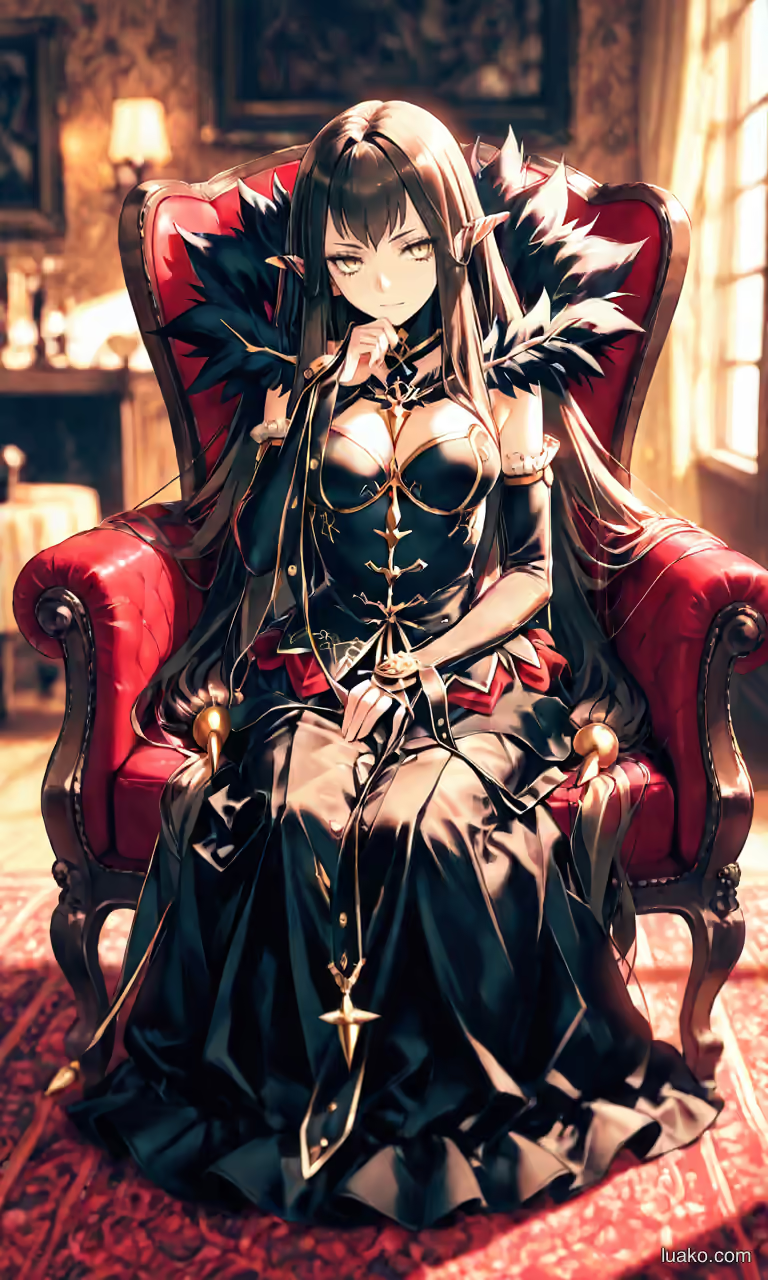
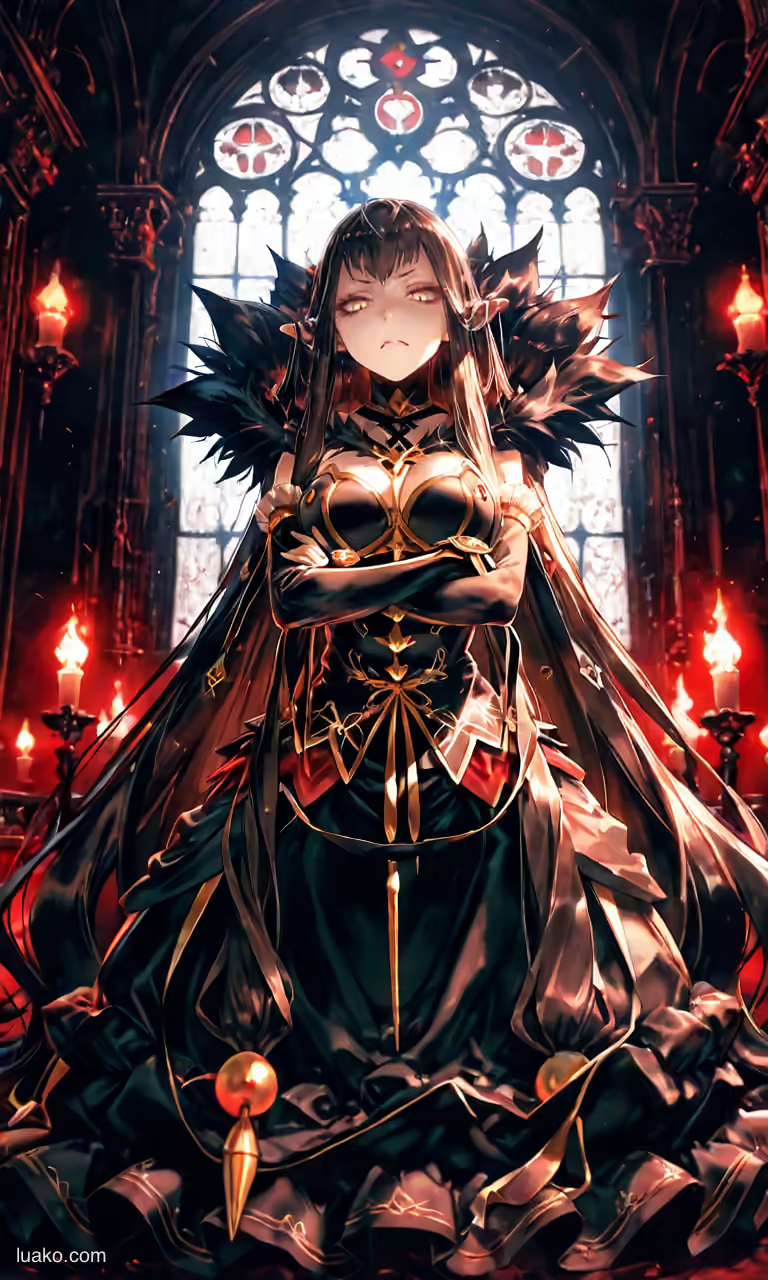
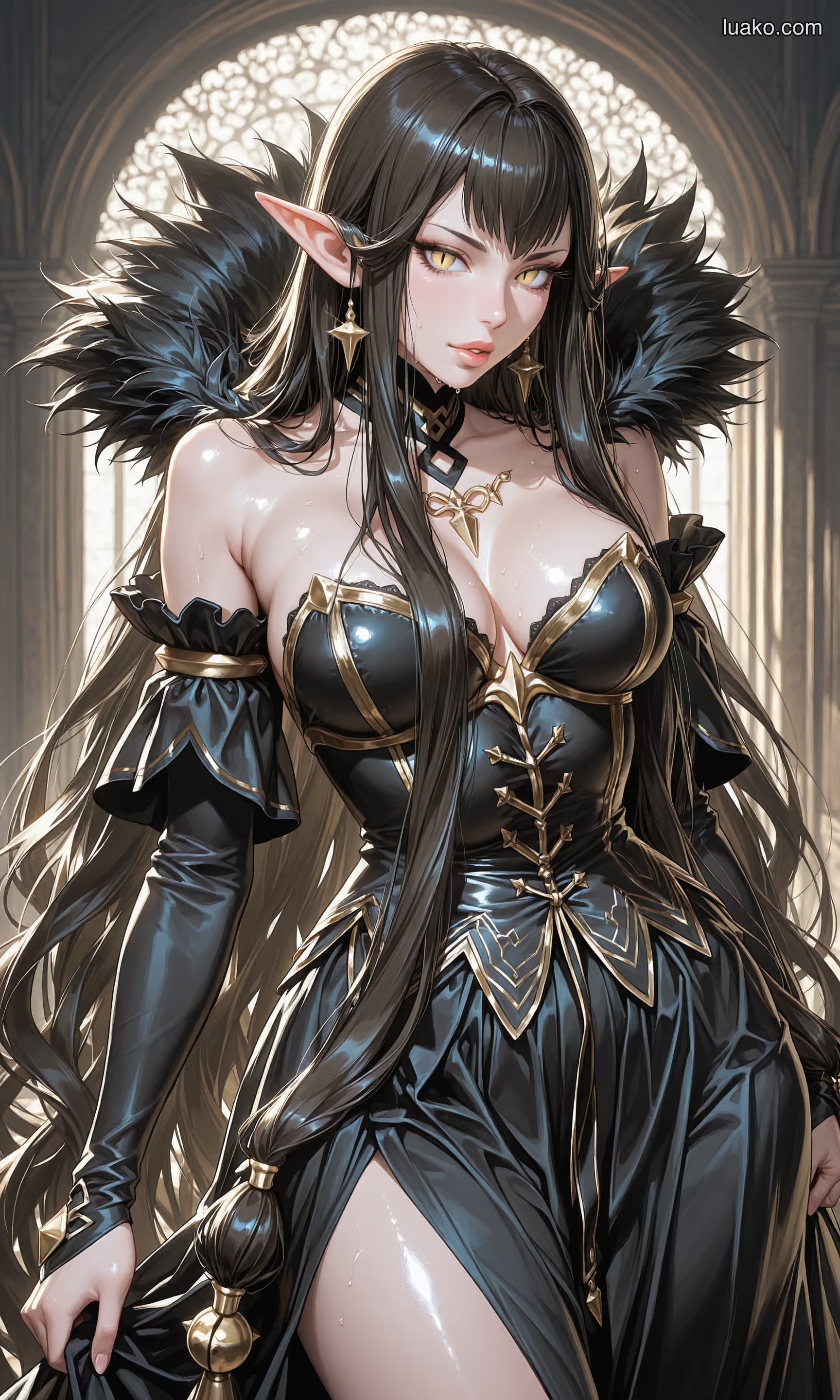
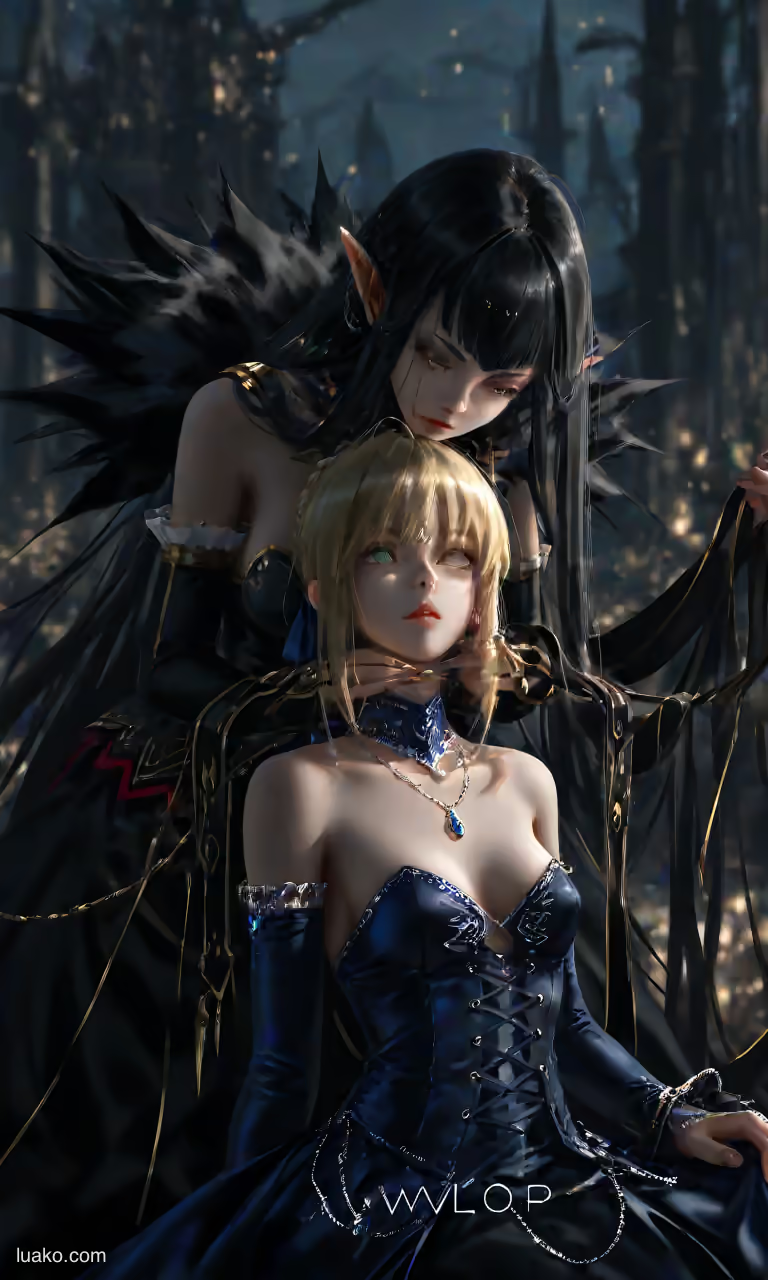
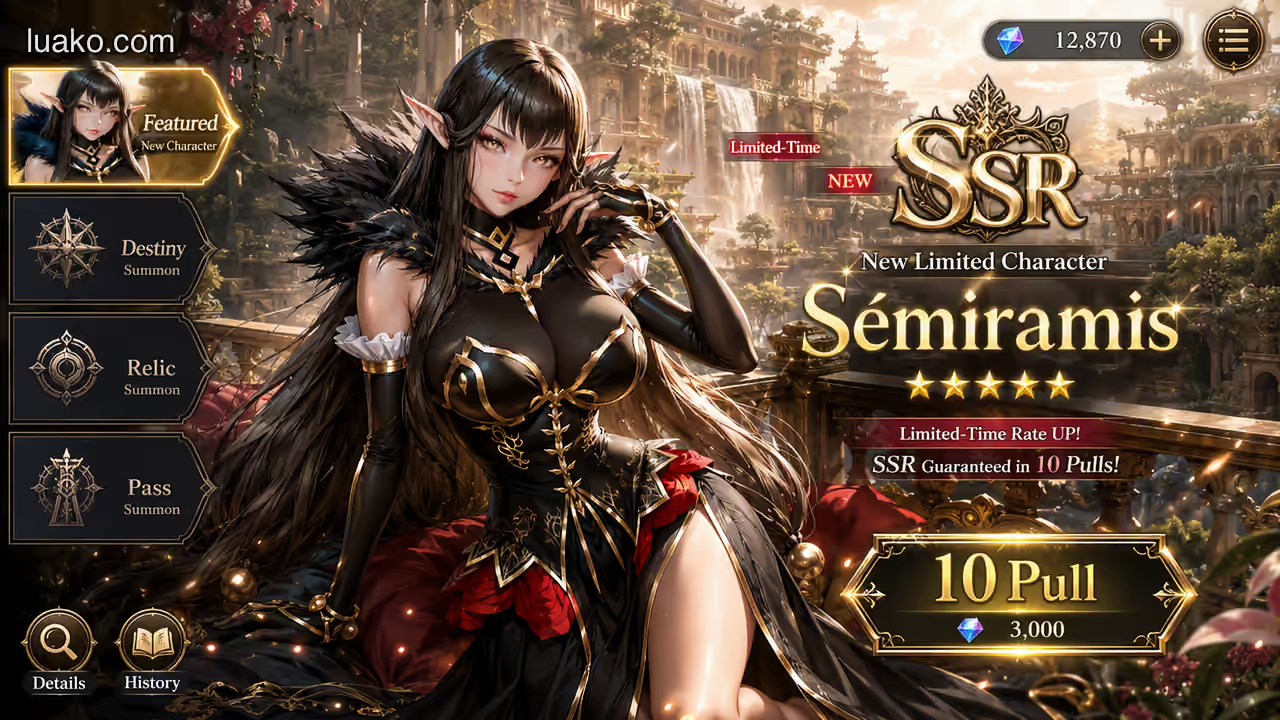
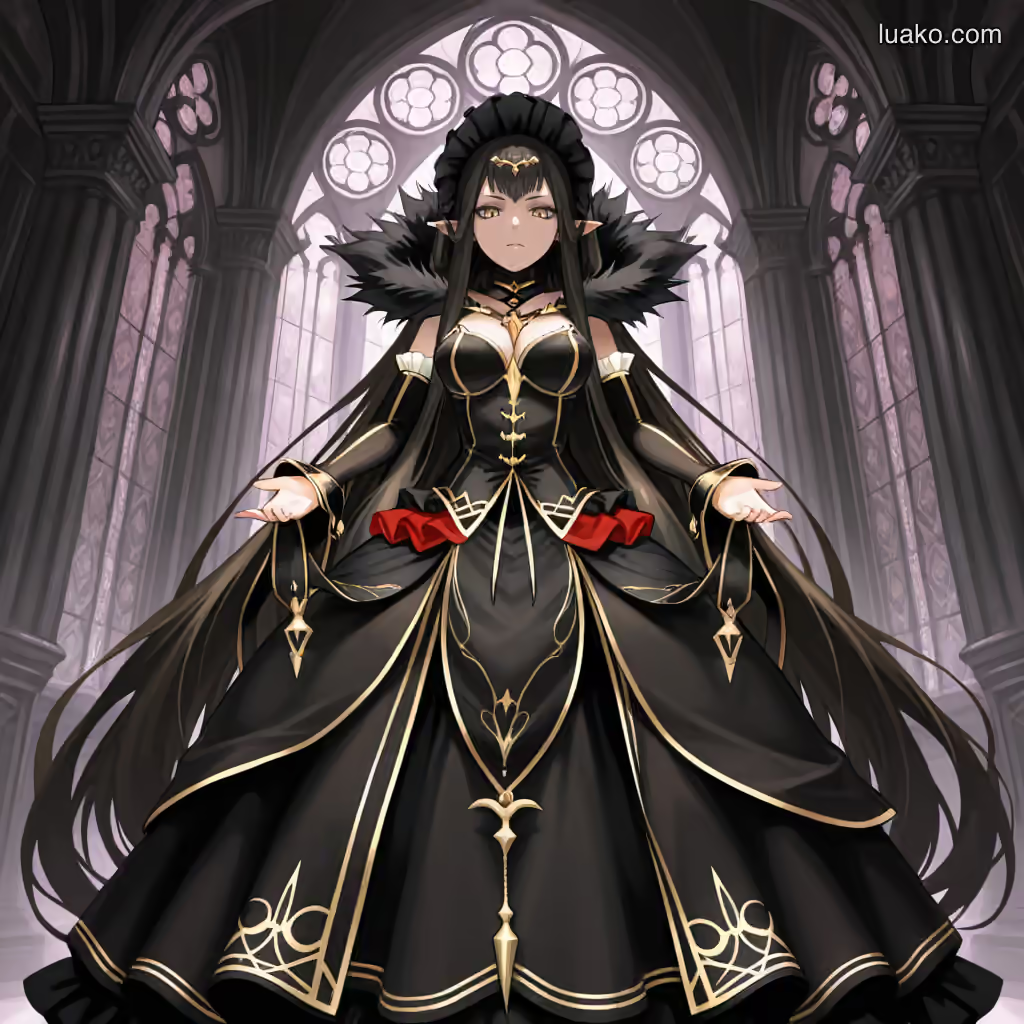
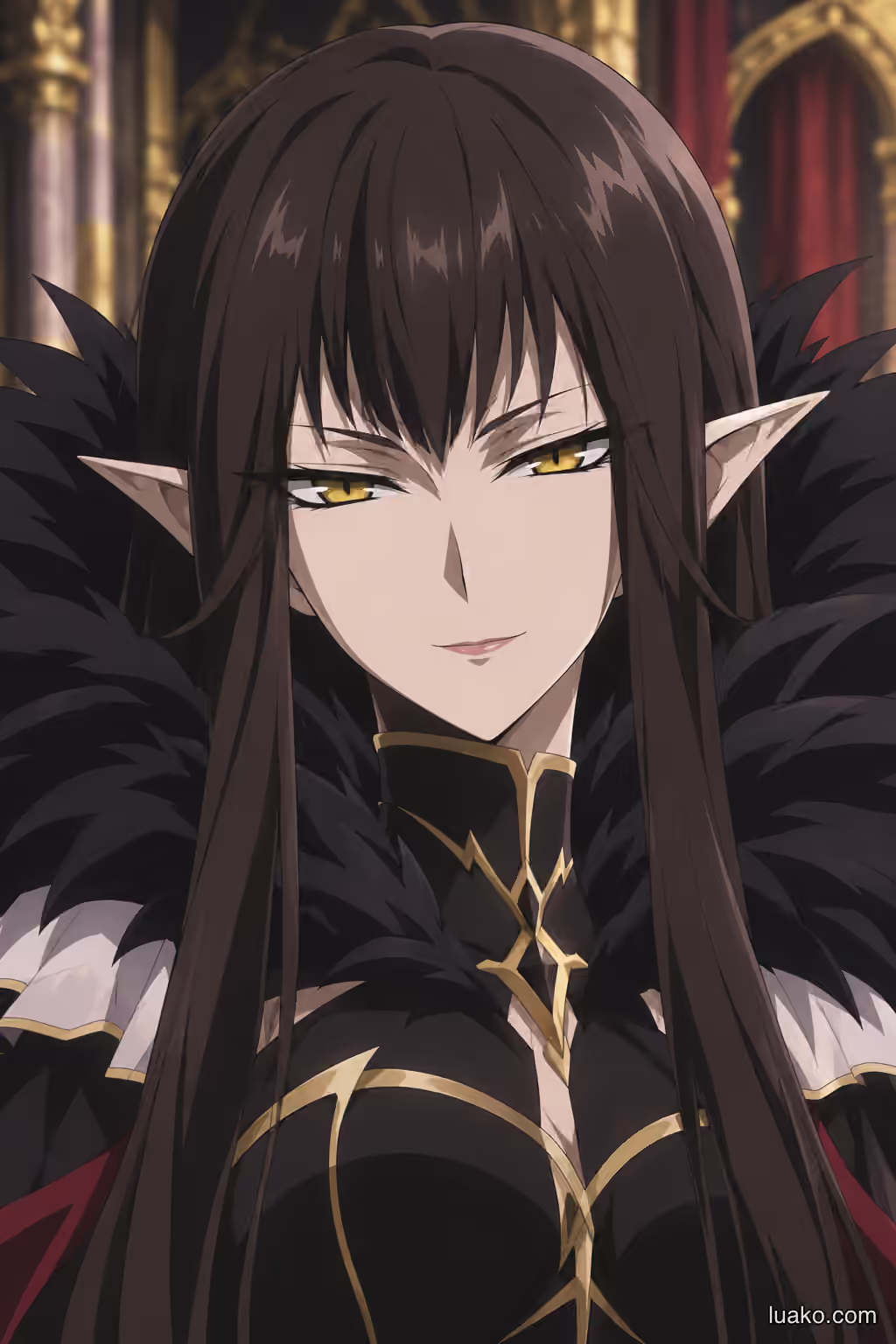
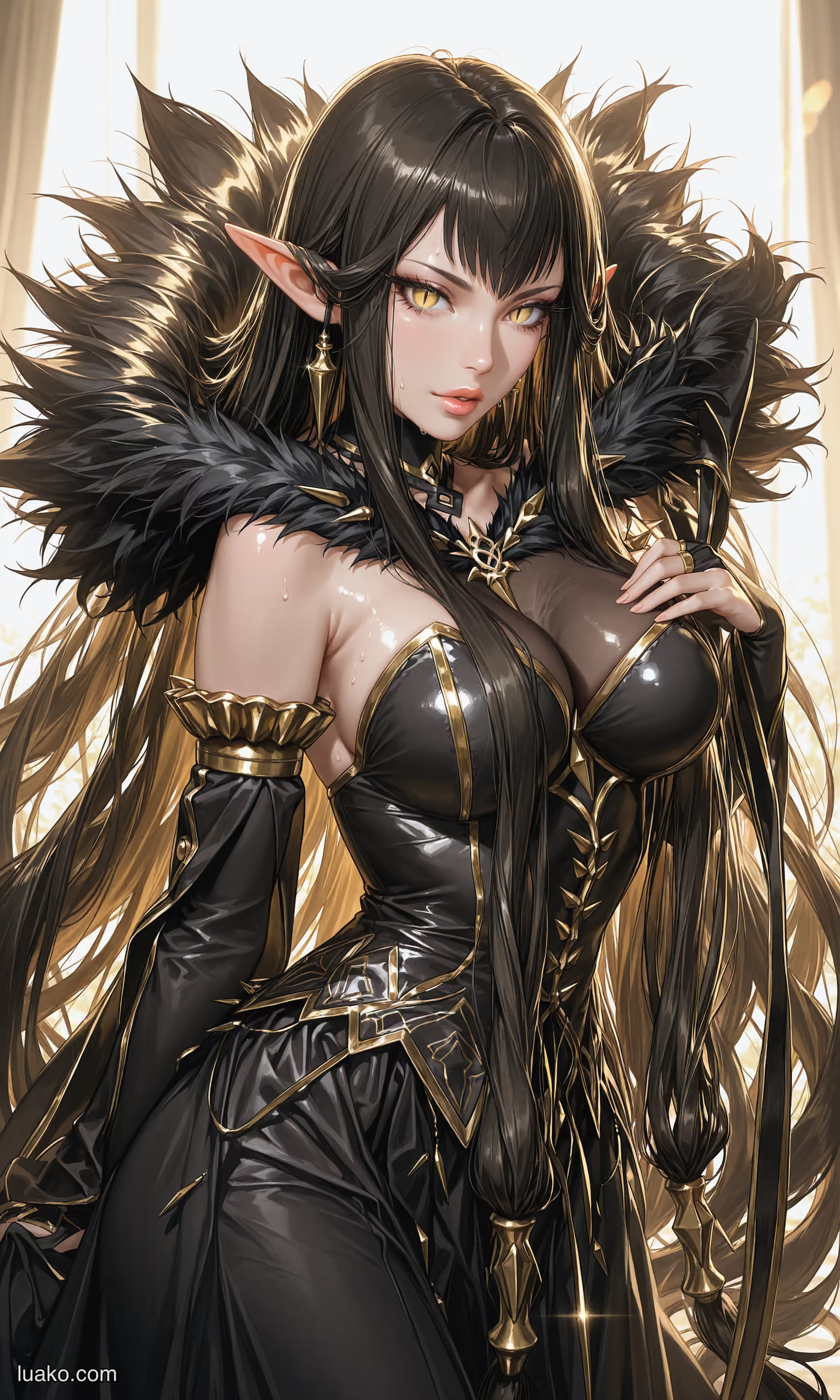
In Fate/Apocrypha’s official character design, Semiramis has extremely long dark hair, pale skin, golden eyes, and distinctively pointed ears. She wears a voluminous black gown with gold trim and red accents; a striking dark feathered collar frames her shoulders. The elaborate, regal silhouette deliberately contrasts with the muted clothing one might expect from an Assassin.
Quick facts
- Servant class
- Assassin of Red
- Legendary identity
- Empress of Assyria
- War
- Great Holy Grail War
- Master
- Shirou Kotomine
- Other class attributes
- Assassin class with Caster-class skills via Double Summon
- Principal stronghold
- Hanging Gardens of Babylon
- Japanese anime voice
- Kei Shindo
- English anime voice
- Allegra Clark
Abilities
Poison expertise and magecraft
She is an expert in poison-based assassination and magecraft. Her Noble Phantasm Sikera Ušum can infuse the surrounding air, magical energy, and attacks with poison; it also enables poison-associated creatures to be summoned while she is within the Hanging Gardens.
Limitations: Its effectiveness varies with an opponent’s poison-related legend: Servants whose stories include resistance to poison gain resistance, while those known to have died from poison are more vulnerable.
Double Summon
Double Summon permits Semiramis to possess the class skills of both Assassin and Caster while her actual Servant class remains Assassin. It makes her large-scale magecraft possible alongside her poison specialty.
Limitations: Double Summon is subject to special conditions at summoning and applies only to compatible classes; it does not grant unrestricted access to the skills of every Servant class.
Hanging Gardens of Babylon
She manifests a gigantic aerial fortress that can fly, protect its occupants, and serve as a formidable magical attack platform.
Limitations: Manifesting the Gardens requires physical materials on an extraordinary scale and a seventy-two-hour ritual. The resulting fortress is conspicuous and cannot easily be defended by Semiramis alone.
Planning and political command
Her legend credits her with strategic counsel and government, and in the Great Holy Grail War she helps plan and command operations rather than acting as a disposable front-line fighter.
Relationships
Shirou Kotomine
Master and strategic partner
Shirou summons Semiramis as his Assassin-class Servant and relies on her strategic judgment in the Red Faction. His willingness to work alongside her rather than simply admire her rank makes the partnership unusual. Their later personal story is kept behind the spoiler boundary.
Onnes
First husband in her legendary past
An older general who values her intelligence and with whom she shares a close marriage; King Ninus’s intervention ends their life together when Onnes takes his own life.
Ninus
Assyrian king and later husband in her legend
The Assyrian king who forces Semiramis from Onnes, later makes her his queen, and is poisoned by her shortly afterward in the legendary account adopted by Fate.
Derketo
Mother in her legendary origin
The Syrian goddess abandons her infant daughter, who survives through the protection of doves.
Interesting facts
Although the Hanging Gardens bear her name in Fate, the companion material explicitly says she was not their historical builder.
The Noble Phantasm exists because a mistaken legendary association became powerful enough to take shape in the Fate setting.
The companion material notes that Semiramis enjoys decadent luxury without actually disliking simple pleasures.
It complicates her imposing royal persona: her taste for spectacle does not mean she is incapable of appreciating modest comforts.
For an Assassin, Semiramis has relatively low Agility and Presence Concealment; she is also poorly suited to defending the Hanging Gardens single-handedly.
Her overwhelming fortress does not erase the weaknesses of an individual Servant. The unusually large, team-based war is especially favorable to her style of combat.
Frequently asked questions
Who is Semiramis in Fate/Apocrypha?
She is Assassin of Red, a Servant based on the legendary Assyrian empress. She fights through poison, exceptional magecraft, and the Hanging Gardens of Babylon.
Who summoned Semiramis?
Shirou Kotomine summons her as his Assassin-class Servant in the Great Holy Grail War.
Is Semiramis an Assassin or a Caster?
Her Servant class in Fate/Apocrypha is Assassin. A rare skill called Double Summon grants her important Caster-class traits as well.
What is the Hanging Gardens of Babylon?
It is Semiramis’s airborne fortress Noble Phantasm, capable of defense and magical attacks. Its creation demands costly materials and extensive preparation.
Why does Semiramis use poison?
Poison is central to the Assyrian empress’s legend as Fate tells it. As a Servant, she specializes in poisoned environments and magecraft, notably through Sikera Ušum.
What does Semiramis look like?
Her signature design features exceptionally long dark hair, pointed ears, gold-toned eyes, and an elaborate black-and-gold gown with red accents and a feathered collar.
Major story spoilers below.
Shirou’s true objective and the stolen Grail
Shirou Kotomine is revealed to be Amakusa Shirou Tokisada, a Servant who plans to use the Greater Grail and the Third Magic to grant humanity salvation. Semiramis commits herself to the attempt rather than merely pursuing a factional victory. Her Hanging Gardens becomes the Red Faction’s moving command center and enables the seizure of the Greater Grail from Yggdmillennia.
Their alliance is more personal than it first appears. Amakusa values Semiramis’s abilities without the worshipful attention she expects; his promise that she could rule the world does not ultimately matter as much as his unwavering resolve. The companion material describes her growing attachment and her difficulty understanding feelings that do not fit her accustomed view of others as subjects.
The throne-room battle with Mordred
When Mordred and her Master, Kairi Shishigou, reach the Gardens’ throne room, Semiramis uses her advantage within that domain to overwhelm Mordred with poison. Kairi returns with an antidote, allowing Mordred to fight on despite the danger. Semiramis calls upon Sikera Ušum and the gigantic poisonous serpent Bašmu, but has time to manifest only part of the creature. Supported by Kairi’s Command Spell, Mordred lands a devastating blow that mortally wounds Semiramis. Kairi suffers fatal injuries in the encounter, and Mordred likewise does not survive its aftermath.
A final farewell
Mortally wounded, Semiramis nonetheless lives long enough to reach Amakusa after his final defeat. She cradles him as he faces the failure of his plan, offers him a kiss, and remains with him until his death. Semiramis also fades away as the Hanging Gardens begin to collapse. She never betrays the Master whose strange ideal first drew her attention.
Her closing moments do not turn her into a different person. The queen whose legend is built on poison, revenge, and dominion chooses to stay beside someone who sought her strength without submitting to her. The companion material portrays her recognition of that attachment as late and difficult, rather than as a simple decision to abandon ambition for a conventional romance.
Additional story facts
The Fate/Apocrypha companion material explicitly contrasts Semiramis’s childhood abandonment with Atalanta’s own abandonment.
It adds a quiet parallel between two Red Faction Servants whose shared origin does not make their adult attitudes alike.
During the throne-room fight, Semiramis summons only Bašmu’s upper half; the companion material says there is not enough time to manifest the entire divine beast.
The partial manifestation and Kairi’s Command Spell are specific limits on an otherwise terrifying attack, helping explain why Mordred survives long enough to strike back.
Spoiler questions
Does Semiramis betray Shirou Kotomine?
No. She continues to stand beside Amakusa Shirou Tokisada through the failure of his Grail plan and remains with him at the end.
Who defeats Semiramis?
Mordred, with decisive help from Kairi Shishigou’s antidote and Command Spell, mortally wounds Semiramis in the Hanging Gardens’ throne room. Kairi and Mordred also die as a consequence of the battle.
Does Semiramis die in Fate/Apocrypha?
Yes. Mortally wounded by Mordred, Semiramis survives long enough to be with the defeated Amakusa Shirou. She kisses him before he dies, then fades away herself.
Does Semiramis love Amakusa Shirou?
She develops an attachment far beyond their strategic alliance. The companion material describes a feeling she struggles to recognize, and their final exchange and kiss make her affection clear without establishing a conventional romantic partnership.
What is Semiramis’s ultimate aim in the war?
She works toward Amakusa’s use of the Greater Grail and the Third Magic to save humanity. The companion material indicates that the prospect of ruling the world is not, by the end, what matters most to her.
Tags
Semiramis Images and Artwork
Browse Semiramis artwork and explore the regal design of Fate/Apocrypha’s Assassin of Red.
Videos · 1