Astolfo — Fate/Apocrypha
Interesting factsBiographyThe story, the personality, and everything in between.Read biographyClose biography
Astolfoアストルフォ
Rider-class Servant of the Black faction; one of Charlemagne’s Twelve Paladins
Astolfo is the Rider of Black in Fate/Apocrypha, a Heroic Spirit summoned to fight for the Yggdmillennia faction in the Great Holy Grail War. His true identity is one of Charlemagne's Twelve Paladins, remembered for extraordinary adventures rather than overwhelming martial strength. Cheerful, impulsive, and unusually unwilling to abandon someone in trouble, he treats the people around him as individuals even when the war demands that they be treated as assets.
Biography
A paladin whose adventures outran his judgment
In the legends used by Fate/Apocrypha, Astolfo is a paladin serving Charlemagne and a son of King Otto of England. The Twelve Paladins include celebrated warriors such as Roland, but Astolfo is not presented as one of their greatest fighters. His distinctive strength lies in an irrepressible willingness to set off on adventures, survive mishaps, and come back carrying something unexpected.
His stories include encountering the giant Caligorante, overcoming harpies with a magical horn, and acquiring enchanted objects that become part of his Heroic Spirit armory. Many of these treasures come into his possession through unusual circumstances rather than victories in straightforward tests of strength. His generosity and lack of possessiveness are as recognizable as his luck.
Roland and the journey to the Moon
Astolfo is especially associated with Roland, another of Charlemagne's paladins. When Roland loses his sanity after heartbreak, Astolfo embarks on an extraordinary journey to the Moon to retrieve the reason his friend has lost. The legend also plays with Astolfo's own famously unreliable judgment: the rationality he briefly recovers does not stay with him for long.
Astolfo's distinctive clothing is connected in Fate/Apocrypha's supplementary material to his attempt to cheer Roland after heartbreak. The disguise did not restore his friend's spirits, but the gesture fits Astolfo's readiness to try even an unlikely solution for someone he cares about.


Rider of Black
Astolfo is summoned in the Rider class by the Yggdmillennia magus Celenike Icecolle Yggdmillennia. He belongs to the Black faction, one side of a conflict that pits seven Servants against seven opposing Servants. The class fits his bond with a flying Hippogriff, while his assortment of other Noble Phantasms makes him useful in unconventional situations.
Astolfo's bright manner and disregard for carefully guarded secrets make him an awkward fit for a group of calculating magi. More importantly, he does not accept the idea that winning the war automatically matters more than helping a vulnerable person. That conviction becomes central when he encounters a homunculus boy in the Yggdmillennia citadel.
A hand offered to someone with no freedom
The boy later known as Sieg has been created to serve the magi's war effort. Astolfo reaches out to him and helps him seek an existence beyond the purpose for which he was made. The decision is dangerous for a Servant whose own faction expects obedience, but Astolfo responds to the boy's predicament before considering which side would benefit.
Their early connection reveals an important distinction in Astolfo's character: he may speak before thinking, but his impulsiveness is not the same as cruelty or indifference. His instinct is to help someone who asks, even when a practical commander would call that choice foolish.


Personality and Motivations
Astolfo is exuberant, direct, fond of adventure, and conspicuously bad at keeping secrets. His 'Evaporation of Reason' is an actual Servant skill, so his lapses in caution are not merely a running joke about a silly knight. Yet he can be startlingly decisive when someone else's freedom or safety is at stake.
He knows that he is relatively weak as a knight among legendary champions and does not build his self-worth around being the strongest. His actions suggest a practical kind of courage: he moves toward the person who needs him rather than waiting until victory is guaranteed.
His kindness is expansive rather than calculating: he offers help without expecting a reward and speaks affectionately without treating gender as a barrier to love. For Astolfo, an individual's wishes matter more than rank, political advantage, or what a magus believes that individual was made to do.
Appearance
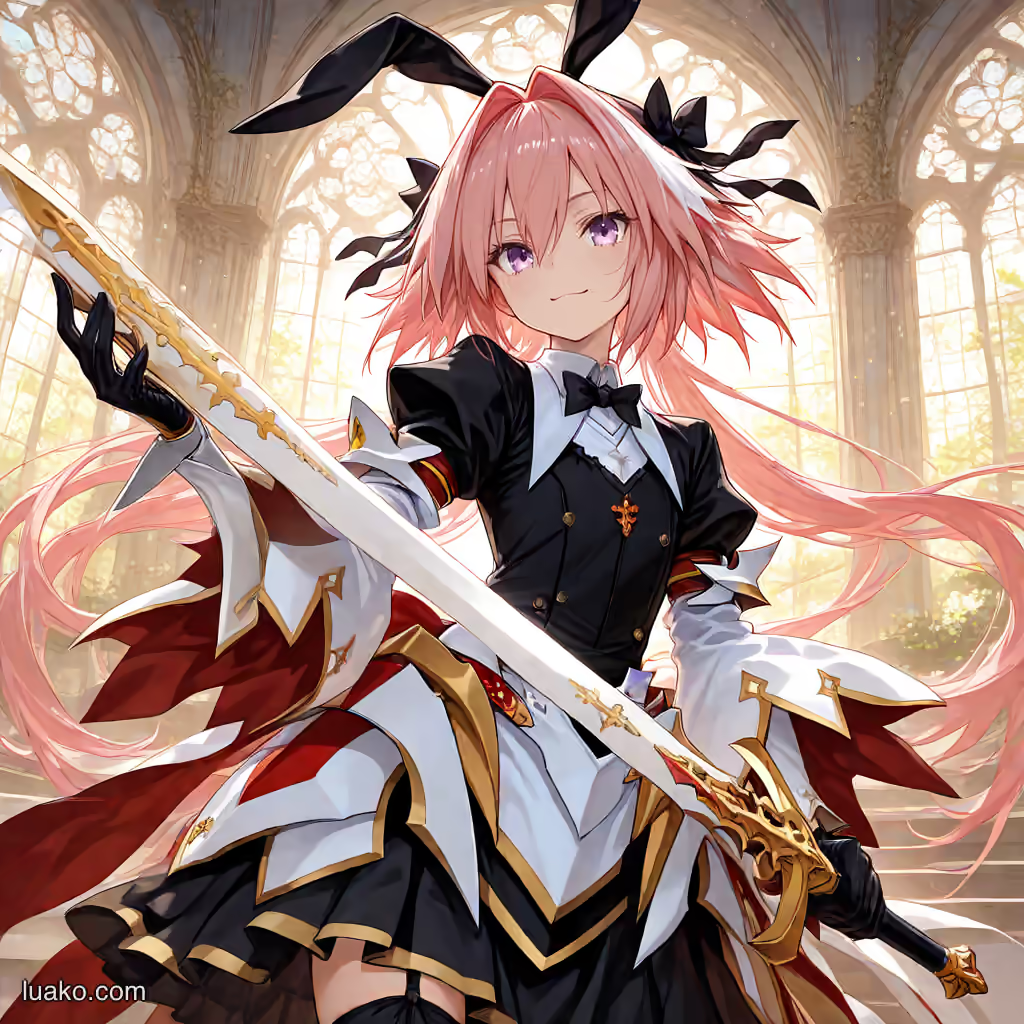
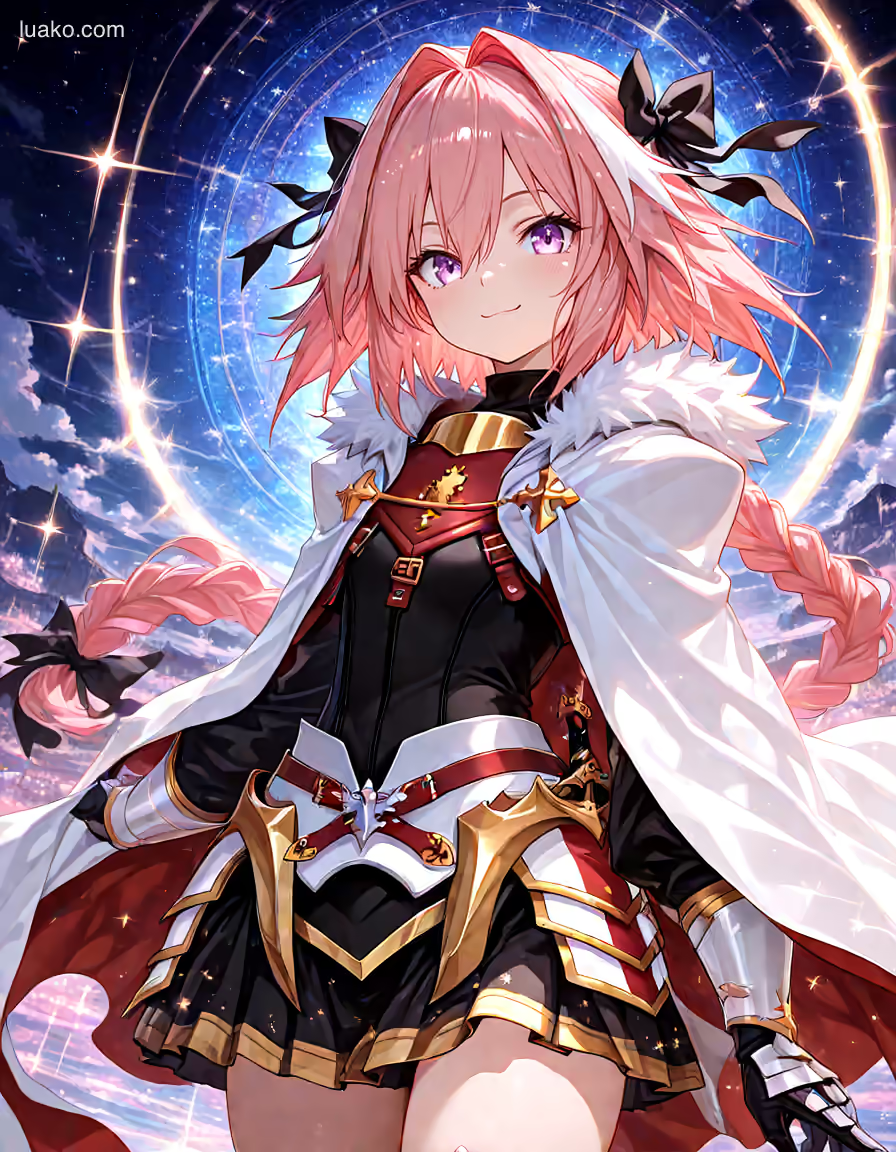
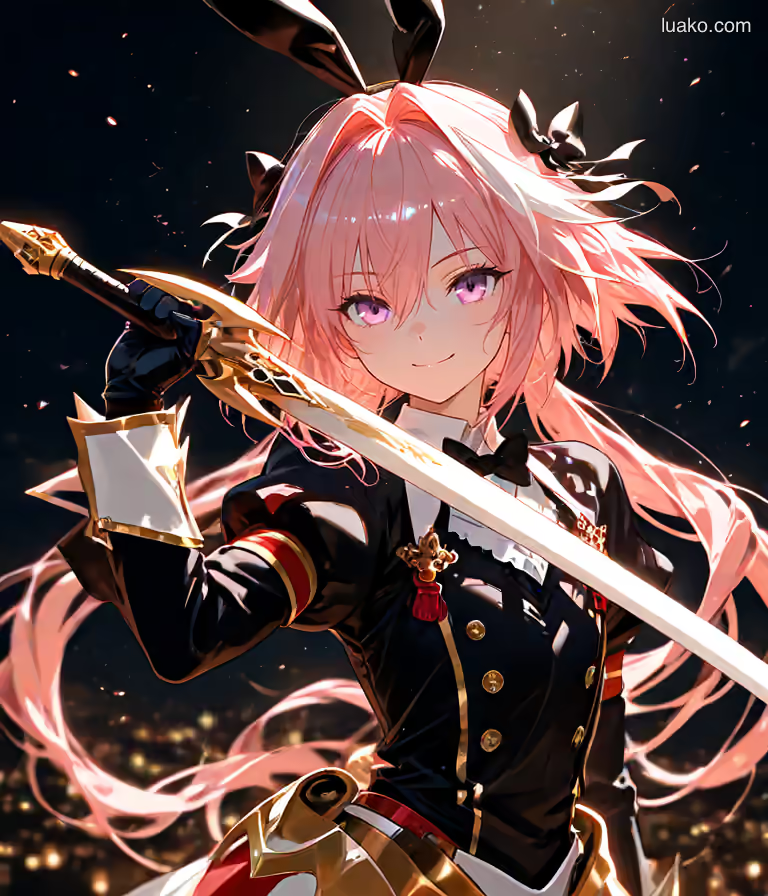
Astolfo is a slender, youthful-looking man with pink hair, magenta-pink eyes, and an androgynous presentation. His character design features long, asymmetrical locks, a conspicuous braid, and dark hair ribbons. The contrast between his playful expressions and knightly equipment is immediately recognizable.
His familiar Rider of Black outfit combines a dark fitted ensemble with white-and-gold armor details, long black stockings, white boots, and a white, fur-trimmed cape with a red interior. Black ribbons accent the pink hair and long braid.
Quick facts
- True name
- Astolfo
- Servant class
- Rider; Rider of Black
- Faction at summoning
- Black faction / Yggdmillennia
- Original Master
- Celenike Icecolle Yggdmillennia
- Legendary affiliation
- Charlemagne's Twelve Paladins
- Gender
- Male; androgynous appearance
- Signature mount
- Hippogriff
- Japanese anime voice
- Rumi Okubo
Abilities
Riding
Astolfo has exceptional skill as the Rider of Black, most notably in directing his flying Hippogriff.
Limitations: He remains comparatively weak in straightforward contests of strength.
Hippogriff: Otherworldly Phantasmal Horse
A flying Phantasmal Beast whose upper body resembles a griffin and lower body a horse. As an 'impossible' creature, it can briefly shift between dimensions so that attacks pass through during that instant.
Limitations: The shift is momentary, not unrestricted access to another world or permanent invulnerability.
Trap of Argalia: Down with a Touch!
A golden jousting lance borrowed from Argalia. Contact with its tip forces a target into a temporary state of falling, disrupting enemies even when the physical damage is slight.
Limitations: The effect is temporary and opponents can recover; the lance's own damaging power is low.
La Black Luna: Magic Flute that Calls Panic
A large magical horn whose explosive blast can scatter lesser foes and sow confusion, fear, or even a temporary loss of hearing. The disruption can create an opening for allies.
Limitations: Its direct power is comparatively modest for an Anti-Army Noble Phantasm, and veteran Servants may fight on despite the disturbance.
Enchanted spell-breaking book
An enchanted book received from the witch Logistilla. Merely carrying it grants Astolfo exceptionally high Magic Resistance, even before he can make use of its full spell-breaking power.
Limitations: Its greater effect requires him to remember and invoke the book's true name; this occurs later in the story.
Evaporation of Reason
A personal skill reflecting Astolfo's vanishing reason: he forgets important matters and blurts out secrets, yet can sometimes instinctively sense a useful move in battle.
Limitations: His inability to keep information confidential can jeopardize his own faction's plans.
Monstrous Strength
An unusual, low-ranked strength-enhancing skill that briefly raises Astolfo's physical power, without placing him among the strongest knights in direct combat.
Limitations: Astolfo takes damage as the enhancement continues; its use is not free of cost.
Relationships
Sieg
Homunculus he befriends and protects
Astolfo helps the boy who later takes the name Sieg pursue his own freedom, prioritizing his life over the interests of the war faction.
Celenike Icecolle Yggdmillennia
Original Master
The Yggdmillennia magus summons Astolfo as Rider of Black. Their bond is a formal Master–Servant arrangement, not proof of compatible values or mutual affection.
Roland
Fellow paladin and friend
Astolfo’s famous Moon adventure is motivated by his wish to restore Roland’s lost reason. Their shared paladin legend provides background to Astolfo’s reckless but wholehearted loyalty.
Charlemagne
Liege and leader of the Twelve Paladins
Astolfo is counted among the renowned paladins who serve Charlemagne in the heroic tradition used by Fate/Apocrypha.
Jeanne d'Arc
Ruler and fellow participant in the war
Jeanne becomes involved in protecting the homunculus boy Astolfo helps; their paths intersect as the conflict widens beyond the two original factions.
Interesting facts
Astolfo is quick to lend away magical treasures, sometimes without remembering to ask for them back.
His unusual equipment is associated with an equally unusual lack of attachment to possessions.
On his legendary journey to recover Roland's reason, Astolfo travels to the Moon in a fiery-horse chariot borrowed from Saint John, not on the Hippogriff.
The detail distinguishes his Moon adventure from the mount for which he is best known as a Rider-class Servant.
Astolfo obtains the Hippogriff from the sorcerer Atlante in the heroic background recorded by Fate/Apocrypha material.
The mount has its own place in his earlier adventures; it is not simply a creature invented for the Holy Grail War.
Astolfo takes Argalia's abandoned lance during a chaotic jousting contest and initially credits his subsequent victories to a sudden improvement in his own abilities.
The joke relies on the enormous difference between Astolfo's actual jousting strength and the lance's forced-fall enchantment.
When summoned for the Holy Grail War, Astolfo has not decided what he will wish for if he wins.
He answers the call because someone needs his help, rather than because he has a carefully planned reward in mind.
Ototsugu Konoe created the original character designs for Fate/Apocrypha, while Yukei Yamada is credited with character design for its television anime; Astolfo's Japanese and English voice actors are Rumi Okubo and Faye Mata.
These credits distinguish the original visual conception, anime adaptation design, and two official language performances.
Frequently asked questions
Who is Astolfo in Fate/Apocrypha?
He is Rider of Black, a summoned Heroic Spirit from Charlemagne's Twelve Paladins who fights for the Black faction in the Great Holy Grail War.
Is Astolfo a boy or a girl?
Astolfo is male in the Fate/Apocrypha character materials. His deliberately androgynous appearance and feminine clothing do not change that identification.
Why is Astolfo called Rider of Black?
Rider describes his Servant class; Black identifies the faction to which he is summoned, not his personality or costume color.
Can Astolfo fly?
He can ride his flying Hippogriff, a mythical mount that also has a very brief dimensional-shift ability.
Is Astolfo the strongest paladin?
No. Fate/Apocrypha repeatedly describes him as less formidable in direct combat than many celebrated knights. His courage, luck, and unusual equipment are his advantages.
What is Astolfo’s link to Roland?
They are fellow paladins, and Astolfo travels to the Moon in the traditional story to recover Roland’s lost reason.
What kind of Holy Grail War is Astolfo summoned into?
The Great Holy Grail War features opposing Black and Red factions with seven Servants each, and Astolfo belongs to the Black side.
Major story spoilers below.
The price of saving a homunculus
Astolfo’s decision to help the nameless homunculus escape has consequences beyond a single act of mercy. Siegfried, Saber of Black, eventually gives the dying boy his own heart, allowing him to live. The boy takes the name Sieg and begins forming wishes and decisions that belong to him rather than to the magi who created him. Astolfo remains one of the clearest voices supporting that independence.
Celenike’s Command Spell and a new Master
Celenike’s hostility to Astolfo’s attachment to Sieg becomes a direct threat. She orders Astolfo, through a Command Spell, to kill the boy. Astolfo desperately resists the compelled violence, exposing how strongly his personal sense of right and wrong conflicts with the authority holding his contract.
Mordred kills Celenike before she can issue another Command Spell. Although Astolfo is no longer under the same Master's control, the first command has not immediately lost its force, and Mordred cautions him against moving toward Sieg. Sieg then establishes a new Master–Servant contract with Astolfo. Their rescue becomes a reciprocal commitment rather than obedience to the Black faction.
A weak knight who creates the decisive opening
In the battle against Avicebron’s massive golem, whose connection to the earth is essential to its power, brute force alone cannot solve the problem. Astolfo uses Trap of Argalia to knock the giant off its feet. The brief loss of contact with the ground creates the opening that the stronger heroes need. His supposedly lesser weapon becomes decisive precisely because its effect is so specialized.
A moonless assault and the book’s true name
When Sieg and Astolfo advance on Semiramis's airborne Hanging Gardens, a moonless sky briefly restores Astolfo's missing reason. He remembers the true name of the enchanted book he had casually misnamed: Casseur de Logistille. With its power invoked, he neutralizes the Gardens' magical light-cannon barrage and carries Sieg forward on the Hippogriff.
The scene does not suddenly make Astolfo a superior swordsman. It illustrates the pattern of his whole story: a specific tool, an improbable opportunity, and a willingness to commit himself completely can matter more than conventional rankings.
Sieg’s final choice and Astolfo’s journey
In the final confrontation over the Greater Grail, Sieg rejects Amakusa Shirou's plan to impose salvation on humanity. Transformed into the dragon Fafnir, he takes the Grail to the Reverse Side of the World, where its human-directed miracle cannot take effect. Astolfo survives the conflict, but his Master leaves the ordinary world behind.
After the novels, Astolfo sets out on a wandering journey. Fate/Apocrypha's supplementary material describes him continuing to help those who ask, without demanding payment. It is an open-ended continuation of the same knightly impulse that led him to defend a homunculus despite his own faction's objections.
Additional story facts
Even after Mordred kills Celenike, she warns Astolfo that the lingering force of the Command Spell could still make him turn his weapon on Sieg.
Celenike's death does not instantaneously erase the danger of the compulsion Astolfo has been resisting.
During the assault on the Hanging Gardens, Astolfo's awakened spell-breaking book counters Semiramis's Eleven Black Coffins, powerful magical defensive cannons.
This identifies the specific obstacle his newly remembered Noble Phantasm overcomes, rather than treating the ability as unrestricted general invulnerability.
Spoiler questions
How does Sieg become Astolfo’s Master?
After Celenike tries to compel Astolfo to kill Sieg, Mordred kills Celenike. Sieg then establishes a new Servant contract with Astolfo.
Does Astolfo survive Fate/Apocrypha?
Yes. Supplementary material describes him traveling after the main novels, continuing to help people.
What is the true name of Astolfo’s spell-breaking book?
Casseur de Logistille, the true-name release of the spell-breaking book also identified as Casa Di Logistilla in supplementary material. Astolfo had previously called it Luna Break Manual.
What happens to Astolfo and Sieg at the end?
Sieg transforms into Fafnir and carries the Greater Grail to the Reverse Side of the World. Astolfo remains behind and continues his adventures, helping people in need.
Tags
Astolfo Images and Artwork
Explore artwork of Astolfo, the adventurous Rider-class paladin from Fate/Apocrypha.