Hilichurl — Genshin Impact
BiographyBiography
The story, the personality, and everything in between.Read biographyClose biography
Biography
The story, the personality, and everything in between.Read biographyClose biographyHilichurl丘丘人
Masked humanoid of Teyvat; a common enemy type and member of a wider people, not one named individual
Hilichurl refers to the masked humanoids that inhabit the wilds of Teyvat in Genshin Impact, not to a single named character. Common Hilichurls patrol trails, defend camps, and fight with fists, stones, or simple weapons depending on their type. They also form tribes, share meals, sing and dance, and speak Hilichurlian.
Encounters with researcher Ella Musk show that communication is sometimes possible, even with creatures travelers usually meet as enemies.
Biography
The masked inhabitants of Teyvat
Hilichurls have inhabited Teyvat’s wilderness for more than a thousand years. Records place them on the continent before the calamity of five centuries ago, after which their numbers increased. The ordinary Hilichurl encountered by travelers is not a particular individual with a documented childhood or personal timeline; its wider history belongs to the hilichurl population.
Life around the campfire
Hilichurls settle in small tribes with shelters, campfires, sentries, and shared supplies. In his field notes, Mondstadt ecologist Jacob Musk compares a tribe to an extended family: its experienced shaman may guide decisions and protect the group with elemental power, although a stronger fighter can displace that leader. His descriptions are observations of particular communities, not rules governing every settlement.
The settlements of Dadaupa Gorge show how different those communities can be. The Meaty Tribe maintains a boar pen, a communal stewpot, and an arena for challenges; the Sleeper Tribe makes its huts comfortable for rest; and the Eclipse Tribe gathers around an eclipsed-sun emblem and its shamans’ rituals. None of these regional traditions defines every Hilichurl in Teyvat.

A voice travelers can learn to recognize
Hilichurls communicate in their own language, Hilichurlian. Ella Musk’s Language Exchange commission allows a traveler to approach one without immediately fighting. A practical handbook records expressions such as “dada” for approval, “mita” for meat or other desirable things, and “gusha” for plants or disliked things. Tone and situation matter: a single word is not a complete translation of the speaker’s intentions.
Threats, tools, and misunderstandings
The common unarmed Hilichurl strikes and throws small stones. The club-carrying Hilichurl Fighter and crossbow-wielding Hilichurl Shooter are distinct enemy types, so their equipment should not be attributed to every member of the group. The Shooter’s archive description notes a further puzzle: Hilichurls are not considered capable of making those crossbows, prompting suspicion of an outside supplier but not identifying one as fact.


Behavior and Temperament
There is no one personality shared by all Hilichurls. Many attack intruders and fiercely guard their camps; others may tolerate a cautious approach. Outside combat, they can be seen patrolling, dozing, dancing, and watching one another. The same masked figure that threatens a traveler may take part in the ordinary routines of a settlement.
Their behavior also reflects local custom. Shamans organize ceremonies and lead communal song, while the Meaty and Sleeper tribes devote very different amounts of attention to feasting and rest. Those group habits offer texture without giving an otherwise anonymous Hilichurl invented memories, motives, or relationships.
Appearance
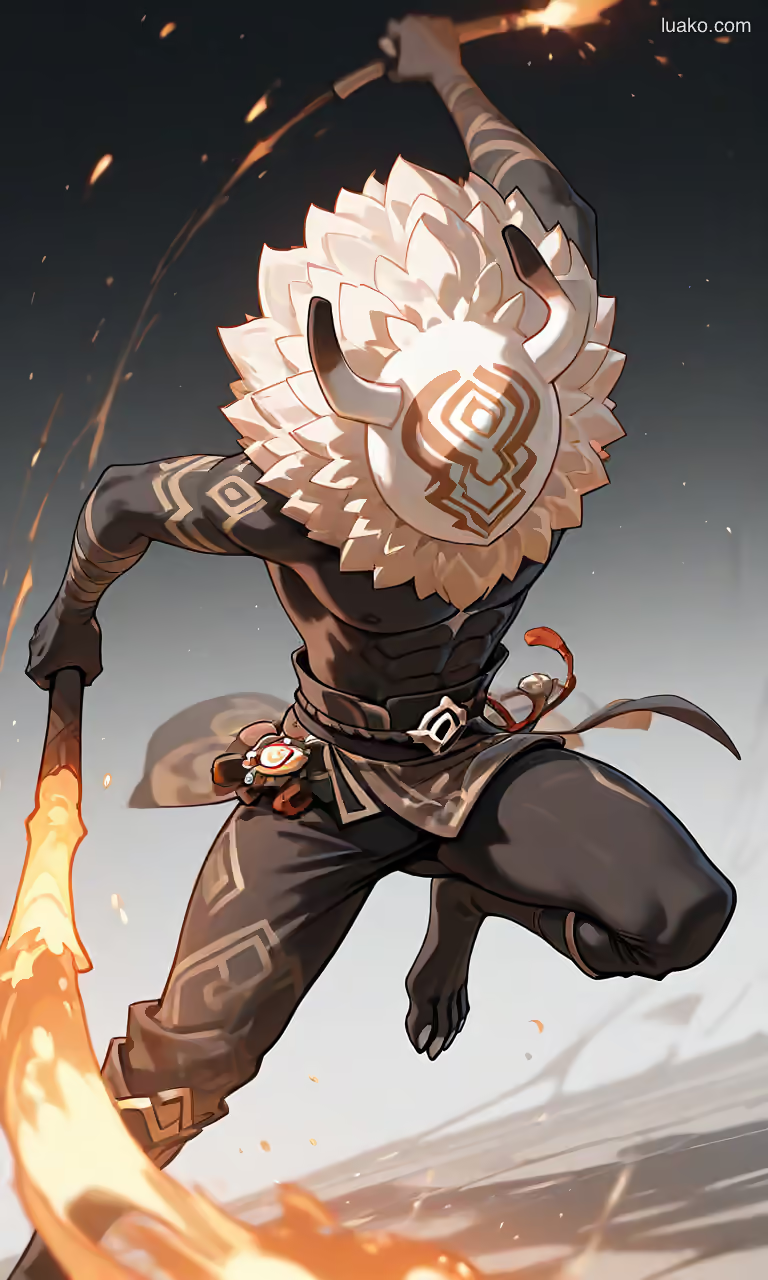
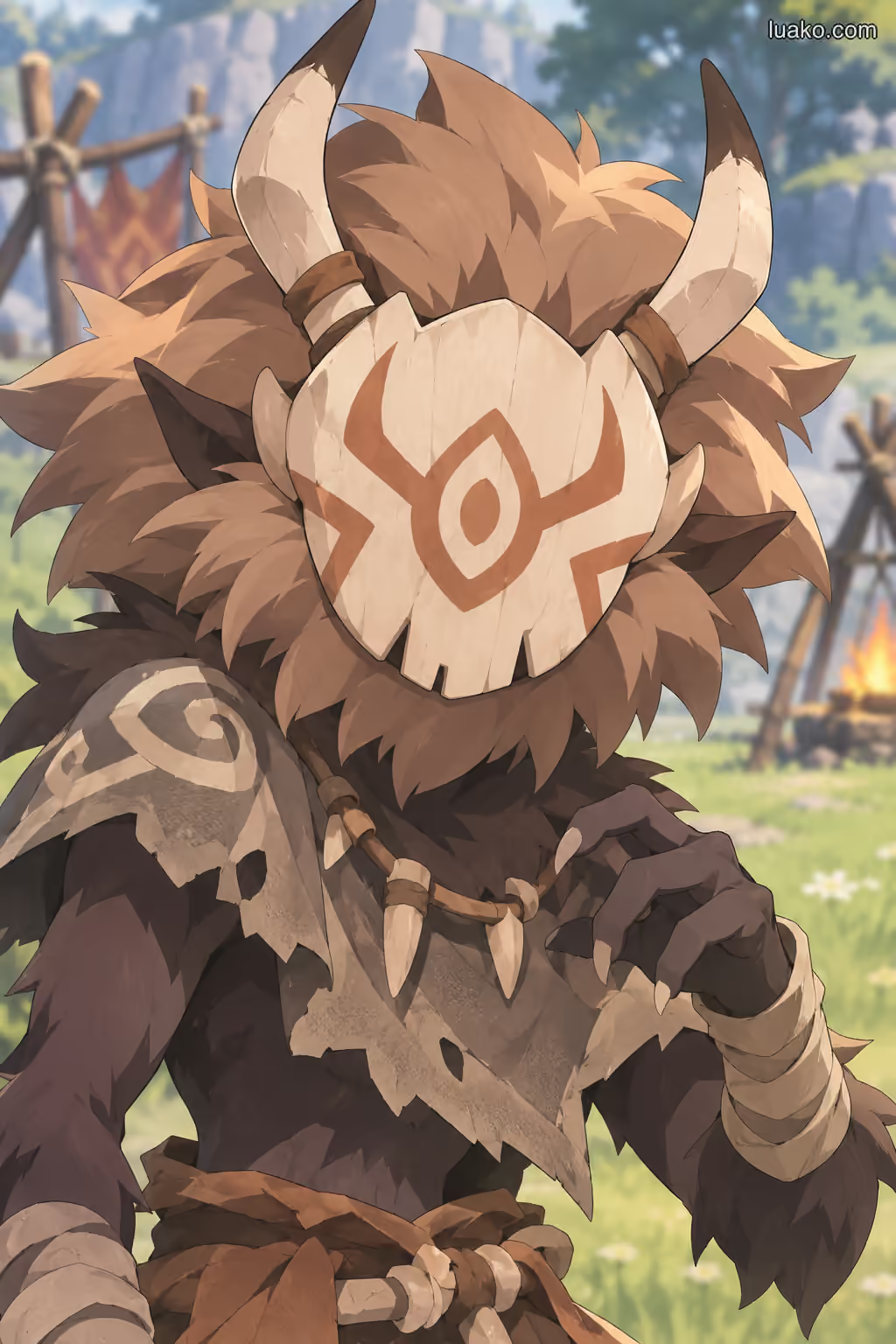
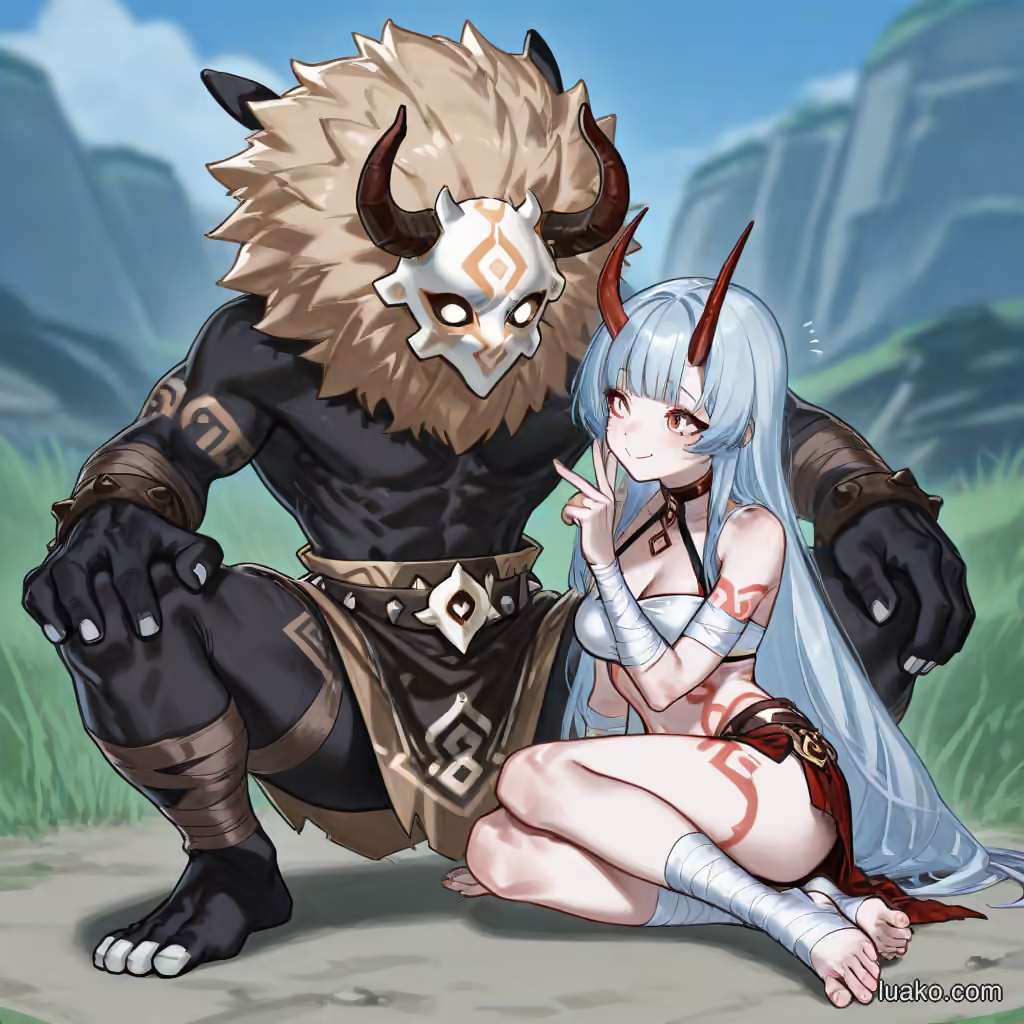
The ordinary Hilichurl has a compact, grayish-dark humanoid body, bare feet, wrapped limbs, a rough loincloth, and a broad pale mask marked with angular designs. A shaggy tan mane frames the mask, with projecting ears and horn-like features shaping its silhouette. Equipment varies by enemy type: a club-wielding Fighter, a crossbow-using Shooter, a staff-bearing Samachurl, and a towering Mitachurl should not all be portrayed as the same model.
Quick facts
- Type
- Common enemy type within a wider masked humanoid population
- World
- Teyvat
- Typical habitat
- Wilderness paths, ruins, and tribal camps
- Language
- Hilichurlian
- Organization
- Tribal communities; shamans often guide them, though powerful fighters may take over
- Named regional groups
- Meaty, Sleeper, and Eclipse tribes in Dadaupa Gorge
- Historical record
- Hilichurls were reported more than a thousand years ago
Abilities
Unarmed fighting and stone throwing
A basic Hilichurl can attack with its fists or throw small stones in combat.
Limitations: Applies to the ordinary unarmed Hilichurl, not every specialist in the wider enemy family.
Rough weapon use
Fighter and Shooter variants wield clubs and crossbows respectively, making them more dangerous at different ranges.
Limitations: Variants use distinct equipment; a club-carrying Fighter does not thereby become a Shooter.
Coordinated tribal activity
Hilichurls patrol, keep watch, defend their camps, share supplies, and participate in communal feasts or ceremonies.
Limitations: These are observed group behaviors, not proof that every member leads a tribe or wields elemental power.
Interesting facts
A field account of the Meaty Tribe describes a cooking fire heated by a Pyro Slime.
It is a particularly concrete example of how fantastical wildlife appears in the practical routines of a Hilichurl settlement.
The Hilichurlian handbook says some Hilichurls hoard seeds and occasionally bury them when in a good mood.
This small, easily overlooked habit is more individual and playful than their usual enemy-archive description suggests.
In Hilichurlian, “mani” can mean both “five” and “hands” or physical labor.
It reveals an unusual connection within the documented vocabulary rather than simply listing another combat call.
The in-game account describes Lawas as powerful loners who are respected but generally do not rule tribes.
It challenges the obvious assumption that the biggest Hilichurl must also be the group’s leader.
The Hilichurl Shooter archive questions how crossbows are supplied and raises suspicion about outside involvement without proving a specific supplier.
This distinguishes an in-world conjecture from established fact.
A documented hilichurl bonfire ballad ends with its leader calling “nunu” three times.
The closing call links documented song traditions to the end of a communal evening, not merely to fighting or enemy voice lines.
Some hilichurl tribes in Mondstadt revere elemental Anemo power without treating Barbatos, the Anemo Archon, as the object of their worship.
Their religious practices cannot simply be equated with the beliefs of neighboring human communities.
In the Hilichurl Cultural Customs account, shamans paint themselves in colors associated with the elemental power they honor.
Body paint and mask designs can signal religious or elemental affiliations within a camp.
Frequently asked questions
Is Hilichurl a specific named character?
No. “Hilichurl” ordinarily identifies a type of creature or a wider group in Genshin Impact, not one named individual with a personal biography.
Are all Hilichurls hostile?
Many attack approaching travelers, but peaceful encounters and limited communication are possible, as shown in Ella Musk’s Language Exchange commission.
What language do Hilichurls speak?
They communicate in Hilichurlian. In-game study materials document words and expressions, although some translations remain context-dependent.
What is the difference between a Hilichurl and a Mitachurl?
Mitachurls are much larger and stronger members of the broader hilichurl family; an ordinary Hilichurl is a smaller common enemy.
Can ordinary Hilichurls control elements?
Not as a standard ability. Samachurl shamans and certain other specialized hilichurls use elemental powers, while the ordinary unarmed Hilichurl fights physically.
Where are the Meaty, Sleeper, and Eclipse tribes?
These particular named tribes are in Dadaupa Gorge in Mondstadt, each with its own customs and settlement.
Why do Hilichurls dance?
Dancing can be part of communal ritual, including ceremonies led by shamans; Hilichurls are also observed dancing in noncombat situations.
What do Hilichurls eat?
Hilichurls eat meat and other foods, but customs vary by tribe. The Meaty Tribe in Dadaupa Gorge raises boars and cooks a shared stew over a Pyro Slime-heated stove.
Major story spoilers below.
A history older than the Cataclysm
The game’s records place Hilichurls in Teyvat long before Khaenri’ah fell about five hundred years ago. Later quests reveal that the curse of the wilderness transformed some people into Hilichurls, including inhabitants connected to the fall of Khaenri’ah. The catastrophe accounts for an important increase in their number; it is not evidence that every Hilichurl first appeared during that disaster.
The Chasm reveals the tragedy beneath the masks
During Requiem of the Echoing Depths in The Chasm, Dainsleif connects the Hilichurls there to the people cursed after Khaenri’ah’s fall. He explains that they wear masks to avoid seeing their altered faces reflected in water: the sight recalls the people they once were and causes terrible distress. Their curse prevents a natural death while their bodies and minds continue to deteriorate. Some seek the Chasm’s depths because the area briefly eases the curse’s effects.
Caribert shows how individual histories differ
The Caribert Archon Quest gives that suffering a personal history. Caribert Alberich is the son of Chlothar Alberich and a woman from Mondstadt. Because he is not of pure Khaenri’ahn descent, he receives the curse of the wilderness and becomes a Hilichurl; Chlothar, a pure-blooded Khaenri’ahn, suffers a different curse of immortality. Caribert is a named individual with a separate story, not the unnamed ordinary Hilichurl represented by this entry.
Spoiler questions
Why do Hilichurls wear masks?
Dainsleif explains that cursed Hilichurls hide their altered faces to avoid the anguish of seeing their own reflections. This is a major revelation in the Chasm storyline.
Were Hilichurls once human?
The curse of the wilderness can transform people into Hilichurls. This is explicitly shown in the stories tied to Khaenri’ah, but Hilichurls were recorded before the cataclysm, so their entire population cannot be attributed to that one event.
Is Caribert the same as an ordinary Hilichurl?
Caribert is a named person who was transformed into a Hilichurl and has a distinct quest storyline. “Hilichurl” on its own is the generic enemy identity, not an alias for Caribert.
Does the curse make Hilichurls immortal and unharmed?
No. Dainsleif explains that the curse denies a natural death while physical and mental deterioration continue, so prolonged existence is itself part of the suffering.
Tags
Hilichurl Images and Artwork
Discover Hilichurl artwork and the recognizable horned masks, shaggy manes, and wilderness gear associated with these Genshin Impact enemies.
Videos · 7